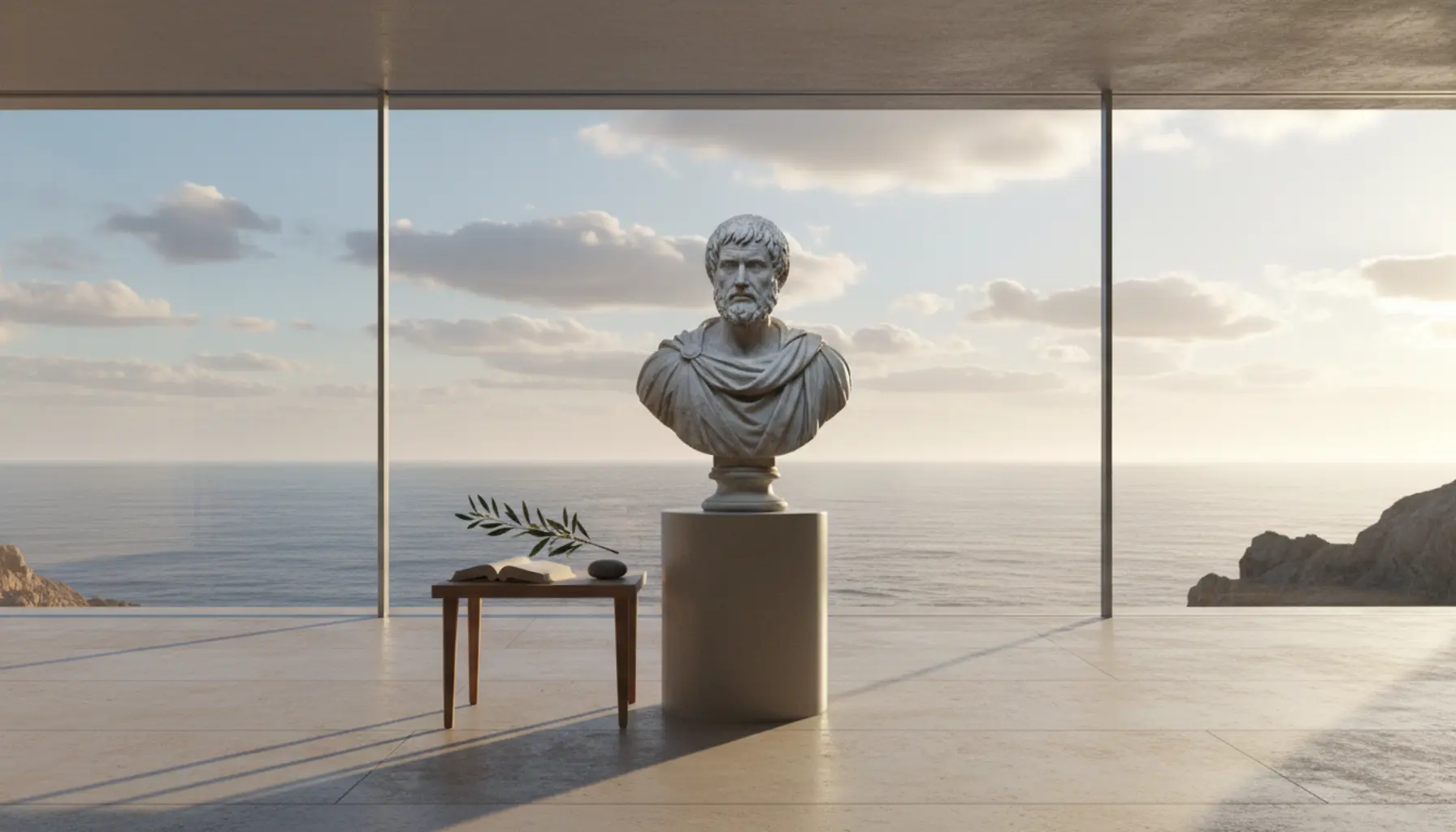
Stoicism: The Philosophy of Calm and Control is a practical approach to everyday difficulties and building inner balance. Stoicism is based on distinguishing between what is dependent on us and what is not, emphasizing self-control, virtue, and acceptance. Discover the methods that help maintain peace of mind despite challenges.
Table of Contents
- Introduction to Stoicism
- Famous Stoics and Their Teachings
- Stoic Practices in Daily Life
- How Stoicism Supports Mental Health
- Stoicism and the Path to Happiness
- Summary: Stoic Philosophy for Every Day
Introduction to Stoicism
Stoicism is a philosophical school that originated in ancient Greece around the 3rd century BC, and its influence has survived to the present day, inspiring psychology, coaching, and even modern stress management techniques. Its founder is considered to be Zeno of Citium, who taught in a portico (stoa in Greek) at the Athenian Agora—which is where the name “stoicism” comes from. In subsequent centuries, stoic thought was developed by, among others, Chrysippus, Seneca the Younger, Epictetus, and Marcus Aurelius—the philosopher-emperor whose “Meditations” are still regarded as one of the most practical guides to inner life. Although the stoics lived in the reality of the Roman Empire and the ancient world, their questions remain very contemporary: how to stay calm in the face of chaos? How to deal with fear, anger, loss, and uncertainty? How to live well when we don’t have full control over external events, the economy, health, or the opinions of others? The answers that stoicism provides turn out to be surprisingly relevant because they are based on universal mechanisms of the human psyche that remain largely unchanged regardless of era. At the center of stoic philosophy are three key ideas: distinguishing between what is dependent and independent of us; virtue as the highest good; and living in harmony with reason and nature. The stoic does not strive to eliminate emotions but to organize and understand them. They believe that the source of suffering is not so much reality itself as our beliefs and judgments about it—largely automatic, often irrational, frequently based on fear or the exaggeration of threats. Therefore, stoic practice relies on changing our way of thinking, developing self-discipline, and shaping a stable, calm character that does not break in the face of adversity. In this sense, stoicism can be seen as a kind of “mental training”, a predecessor to modern cognitive-behavioral therapy (CBT), which also focuses on changing thoughts to change emotions and behavior.
Stoicism is often associated with emotional coldness, lack of feelings, or passive resignation to fate, but this is one of the most common misunderstandings. The authentic stoic does not cut themselves off from emotions but strives not to be ruled by them—so that anger, jealousy, or despair do not take over complete control of their decisions. They seek a state of inner balance that the ancients called “ataraxia” or “apatheia”—not as an absence of feelings, but as freedom from destructive passions. This means the ability to experience emotions with greater awareness, without automatic reactions and without dramatizing. The key tool here is the distinction between things we can influence (our thoughts, decisions, actions, values) and those beyond our control (the past, weather, random events, others’ opinions, certain illnesses). The stoic learns to focus their energy above all on the former, thereby minimizing the sense of helplessness and chronic tension. Instead of endlessly worrying about the future, they focus on what they can do “here and now”—what specific steps to take to react as best as possible in the circumstances. Such an attitude not only strengthens the sense of agency but also promotes mental health by reducing excessive rumination and catastrophic scenarios, which often underlie anxiety and depression. Stoicism also assumes that true happiness (eudaimonia) does not depend on possessions, social status, or external successes, but on the quality of character: honesty, wisdom, courage, and moderation. Living in accordance with these virtues is supposed to bring a deep, lasting peace that does not disappear with job loss, relationship crises, or changes in financial situation. Therefore, the stoic philosophy of calm and control does not encourage escape from the world but active, responsible participation in life—while maintaining inner freedom from that which cannot be predicted or stopped. This combination of realism, practicality, and psychological depth makes stoicism a compass for many people in times of acceleration, information noise, and constant stress, offering a simple, albeit demanding, direction: work on yourself, accept what you cannot control, and cultivate the peace that comes from a well-ordered mind.
Famous Stoics and Their Teachings
Although stoicism originates from the Athenian Stoa, its most important representatives lived in different eras and cultural contexts, which gives this philosophy many shades and interpretations. Zeno of Citium, considered the founder of the school, laid the foundations of a system combining logic, ethics, and physics into a coherent whole, but the writings of Roman stoics—Seneca, Epictetus, and Marcus Aurelius—have survived the best to our times. Each of them brought different life experience to stoicism: Seneca was an influential politician and advisor to Emperor Nero, Epictetus—a former slave who gained his freedom and became a philosophy teacher, and Marcus Aurelius—one of the most powerful people in the world, an emperor who tried to remain inwardly free despite the burden of power. Their teachings are not dry theories; they are practical guides for keeping a calm mind when the environment is unpredictable and emotions are out of control. Zeno primarily emphasized the distinction between what depends on us and what does not, showing that the foundation of freedom is the ability to focus one’s energy on personal judgments, decisions, and attitudes. Chrysippus, another great thinker of early stoicism, refined the school’s logic and ethics, reinforcing the idea that virtue—understood as the perfection of character—is the only true good, while everything else (wealth, health, status) are “indifferents” morally, although they can be preferred or unpreferred. These early principles allowed later Roman stoics to translate stoicism into the language of everyday life, where philosophy became a form of spiritual training, not just metaphysical speculation.
Seneca the Younger, author of numerous moral letters and treatises, focused on how to practice philosophy amidst luxury, political intrigue, and the threat of life, making his teachings especially close to modern readers. He emphasized the value of time as the most precious resource (“It’s not that we have little time, but more that we waste much of it”), encouraging conscious daily management, limiting distractions, and reflecting on what really matters. In his writings, the motif of memento mori recurs—remembrance of mortality, meant not to depress but to organize priorities and reduce fear of death. Epictetus, whose teachings we know mainly through the “Discourses” and “Enchiridion” recorded by his student Arrian, simplified stoicism to a set of practical guidelines accessible to anyone, regardless of social status. His famous distinction between things “within our power” (our judgments, desires, aversions, intentions) and “not within our power” (body, reputation, possessions, others’ opinions, external events) became the basis of modern methods of self-development, cognitive psychology, and even contemporary cognitive-behavioral therapy. Epictetus taught that we achieve peace not when the outside world calms down but when we cease demanding that it meet our expectations. Marcus Aurelius, in “Meditations” written mainly during military campaigns, shows stoicism through the eyes of a person who has immense power but struggles with illness, the loss of children, betrayal, and responsibility for the fate of the empire. His meditations encourage the practice of humility (an awareness of one’s insignificance in the face of nature and time), gratitude for what is, and continuous work on character in the role life has assigned. The common denominator of these three Roman stoics’ teachings is the conviction that philosophy is an exercise—not a one-time discovery of truth, but daily practice in observing one’s own judgments, consciously choosing reactions to events, and systematically forming an attitude based on reason, courage, moderation, and justice. That is why their writings still serve as handbooks for dealing with fear, anger, regret, and uncertainty, and stoicism ceases to be an abstract theory from two thousand years ago, becoming a real tool for building internal control and peace.
Stoic Practices in Daily Life
Stoicism remains alive not because it is a set of abstract ideas but because it proposes specific practices that can be implemented every day, regardless of lifestyle or religious beliefs. The foundation is the conscious distinction between what we can control and what we cannot. In practice, this means that in stressful situations—traffic jams, work conflicts, sudden criticism—we pause for a moment and ask: “What do I really have control over?” Usually, it’s our thoughts, decisions, words, and actions, not the behavior of others or external circumstances. Even asking this question acts as a mental safety brake and helps shift from the reactive “fight or flight” mode to a more reflective, calm state of mind. The stoic practice of daily reflection—morning and evening—involves preparing for impending challenges in the morning and summarizing one’s actions in the evening. In the morning, you can ask yourself: “What kind of person do I want to be today?”, “What difficult situations might I expect and how will I respond consistent with my values?” In the evening, it’s worth analyzing: “Where did I act in line with virtue, and where did I give in to impulsiveness?”, “What can I do a bit better tomorrow?” Such daily practice builds a kind of “self-control muscle”—instead of reacting automatically, we learn to act in accordance with reason. A key technique is also practicing acceptance of what we cannot change. This is not about passivity, but the conscious letting go of resistance to facts: illness, others’ decisions, the past, or inevitable passage of time. The stoic, when confronted with an unpleasant situation, does not repress emotions but observes them with detachment: noticing bodily tension, anxious thoughts, but not letting them define identity or dictate actions. Helpful here is the technique of labeling thoughts: instead of saying “I am useless,” we phrase it as “the thought arises that I am useless.” Such a subtle change in language creates space between ourselves and our beliefs, reducing their emotional weight. Stoics also recommend conscious attention management—directing it towards what is useful instead of feeding on constant stimuli and information that arouse fear or anger. Simple practices, such as limiting mindless social media scrolling, choosing valuable content, or even planned “screen-free windows,” support the stoic idea of living in accordance with reason instead of in a state of constant distraction. Mindful use of time, as Seneca wrote, means consciously deciding: “What will I spend my limited resources of attention and energy on today?” Bringing stoicism into everyday life also includes the practice of voluntary simplicity: from time to time, we forgo comfort—for example, by deliberately choosing a simpler meal, a colder shower, a day without unnecessary expenses—to remind ourselves that our happiness does not depend solely on comfort and possessions. Thanks to that, we fear material losses less and better appreciate what we already have.
In everyday life, stoic work with emotions and relationships is extremely important. Stoics don’t encourage suppression but the ordering and assigning of proper significance to emotions. In practice, the so-called “stoic pause” helps: before you reply to an email that angered you, before you text back a provoking message, or say something in anger, take a few breaths and return to the question: “What kind of person do I want to be in this situation?” Combining this pause with a simple breathing technique—deep nostril inhale, short pause, slow exhale through the mouth—can significantly reduce the intensity of emotions. Instead of asking “why is this happening to me?”, the stoic more often asks: “what can I do with what is happening to me?” In relationships, this means shifting attention from attempting to control others to consciously shaping one’s own attitude: being kind, honest, consistent, even if the other person does not reciprocate. In the spirit of stoicism, you can practice “voluntary kindness”: each day do something small but valuable for others—give sincere praise, listen without interrupting, offer help without expecting immediate reciprocity. This strengthens the sense of agency and builds inner consistency because we act in accordance with the virtues we’ve chosen, not current mood. Complementing this are visualization exercises such as “premeditatio malorum”—thinking ahead about potential difficulties: losing a job, conflict, failed projects. The goal is not to induce anxiety but to mentally prepare and adjust expectations so that problems, if they arise, are not paralyzing shocks. As a result, when a crisis actually occurs, the mind already has a “map” of possible reactions, making it easier to remain calm. In the context of mental health, many stoic practices resemble modern cognitive-behavioral psychology tools: monitoring beliefs, questioning them, working on the interpretation of events rather than the events themselves. A daily “stoic journal” can include brief notes about what thoughts appeared during difficult moments and how to phrase them more rationally. Combined with regular reminders of personal mortality (memento mori)—not to frighten, but to better use the present—stoicism becomes a practice of regaining perspective: it helps distinguish between truly important matters and those that simply consume our energy. Stoic exercises understood this way—reflection, pausing, working with thoughts, voluntary simplicity, preparing for difficulties, and conscious kindness—turn philosophy into a daily training of inner calm and control over one’s life.

How Stoicism Supports Mental Health
Stoicism is appearing more and more often in discussions about mental health because its assumptions align surprisingly well with what modern psychology calls psychological resilience, emotional regulation, or mental hygiene. The central stoic idea—distinguishing between what we can influence and what we cannot control—acts as an informational filter that protects us from becoming overloaded. In practice, this means gradually unlearning the automatic habit of taking responsibility for everything—for others’ emotions, politicians’ decisions, the state of the economy, or past mistakes that can no longer be undone. Instead of reacting chaotically to every piece of news or impulse, the stoic channels their energy towards actions that are possible here and now: improving their character, the quality of their relationships, the ability to handle challenges. Such a change in perspective often brings relief to people prone to worry, excessive responsibility, or guilt because it gradually reduces the number of stimuli we treat as personal threats. Stoicism also disciplines our way of thinking: it encourages us to check whether our beliefs are consistent with facts or are just interpretations fueled by fear. When a difficult emotion arises—jealousy, fear, anger—the stoic does not try to suppress it immediately, but asks: “What exactly do I think about this situation? Is it really as dangerous as it seems? Am I not overestimating the importance of others’ opinions?” This approach greatly resembles cognitive-behavioral techniques, in which we learn to challenge automatic thoughts and replace them with more realistic ones. As a result, emotions cease to have full power over us and become feedback—signals we can understand and order. A key element of stoic work on mental health is also daily reflection: short “daily reports” in which we analyze our reactions, look for moments where we acted on impulse, and plan how to behave more wisely next time. This simple ritual, practiced by ancient stoics, works as regular “tidying up” of the mind: reducing chaos, strengthening the sense of agency, and allowing us to track real progress in self-development rather than focusing exclusively on failures.
Stoicism can also support mental health by changing our relationship with suffering, stress, and uncertainty. Instead of treating difficulties as proof of a “bad fate” or one’s own failure, the stoic sees them as a natural part of human life and an opportunity to exercise virtue: courage, wisdom, self-control, and justice. This way of thinking doesn’t erase pain, grief, or anxiety, but gives them meaning—and that often determines how long and how intensely we suffer psychologically. Practices like “premeditatio malorum” (deliberately imagining possible difficulties) are not meant to induce negativity but to gradually familiarize us with the fact that nothing is given to us forever: health, relationships, possessions, reputation. Viewed psychologically, this approach can reduce the intensity of shock if something difficult actually happens, because the mind already has “pathways” to move more quickly from paralysis to constructive action. Stoic acceptance of reality—understood not as passivity, but as embracing facts as they are—support the reduction of chronic tension. Instead of continuously fighting what is inevitably (the passing of time, aging, changes in others), we learn to invest energy in what we can really change: our decisions, habits, ways of reacting. This approach helps many people work on fear of the future, the feeling of losing control, and the process of recovering from life crises. Equally important for mental health is the stoic emphasis on living according to one’s own values. When daily decisions are consistent with what we regard as right, the risk of internal conflict, shame, and self-regret decreases. In stoicism, intention and effort matter, not the guarantee of success—this frees us from the obsession with results and comparisons to others, which often deepen feelings of inferiority and burnout. Finally, the stoic’s cosmopolitan perspective—the awareness that we are part of a bigger whole, the human community, and nature—can reduce the feeling of loneliness. Practicing kindness, gratitude, and a readiness to help others builds relationships that are some of the strongest “protective buffers” for the mind. Combined with practices of mindfulness, simplicity, and self-discipline, stoicism is not only a philosophical system but also a practical mental health prevention program that strengthens resilience to crises, helps maintain mental clarity, and builds a deeper sense of meaning in everyday life.
Stoicism and the Path to Happiness
In the stoic view, happiness is not a fleeting thrill or a set of favorable circumstances, but a lasting state of inner stability that results from virtue, rationality, and harmony with nature. The stoics called it eudaimonia—“a good state of spirit”—and emphasized that true happiness can neither be bought nor fully assured by status, prestige, or financial security. All things external, in their eyes, are “morally indifferent”—they may be welcome (health, money, sympathy of others) but do not define the quality of our soul. What truly determines happiness is the way we interpret events and the kind of people we become through our choices. The stoic does not say: “I’ll be happy when life finally goes my way,” but: “I will work on my character, because that is the only lasting source of calm.” In practice, this means a shift from “having” to “being.” Instead of chasing one achievement after another that quickly lose their luster, stoics encourage us to ask: what kind of person do I want to be in the face of success, failure, illness, or conflict? The answer leads to the four cardinal virtues: wisdom (good judgment), moderation (control of desires), courage (readiness to face difficulties), and justice (concern for the good of others). Every decision, even a small one, becomes an opportunity to practice one of these virtues and thus to deepen inner satisfaction. Contemporary positive psychology increasingly reaches similar conclusions: lasting happiness is more closely linked to meaning, values-alignment, and the quality of relationships than to the level of material goods. Stoicism anticipated these discoveries by two thousand years, proposing a clear distinction between what is “in us” and what is “outside.” The more energy we invest in cultivating attitudes we can control—honesty, responsibility, kindness, diligence—the less emotional weight we attach to circumstances beyond our control.
The path to happiness according to the stoics leads through a specific kind of freedom: freedom from the tyranny of volatile moods, impulses, and expectations of the world. It’s not about indifference or coldness, but about consciously filtering what we let into our “inner world.” The stoic trains to recognize automatic beliefs (“It’s terrible that this happened”, “I’ll never cope with this”) and replace them with more realistic ones (“This is difficult, but it lies within my power to respond with dignity”). Thanks to this, emotions become signals, not verdicts. When fear appears, instead of fleeing or panicking, the stoic asks: what exactly am I afraid of, what is really at stake, what is my role in this situation? This attitude leaves less space for catastrophic narratives, which often undermine a sense of happiness more than the facts themselves. An important element of the stoic path is also conscious acceptance of life’s fragility: the awareness of transience is not to oppress us but to motivate fuller presence. Seneca wrote that we do not have little time but waste much of it—and one manifestation of that waste is postponing life for later, for “perfect conditions.” Memento Mori prompts us not to wait for a better mood, ideal job, or ideal partner to practice gratitude, kindness, courage, and self-discipline. Each day becomes a training ground and every difficulty—the “material” for strengthening character. It’s a practical, not abstract, approach to happiness: we don’t look for one breakthrough experience, but we build calm satisfaction through daily, often invisible, choices. In this way, stoicism does not promise a life without pain or problems but shows how to find deeper, more stable fulfillment amid the imperfect realities of the world in which we live.
Summary: Stoic Philosophy for Every Day
Stoicism, although born more than two thousand years ago, remains a surprisingly practical guide to modern life, where every day is filled with stimuli, information, and expectations. At the center of this philosophy is a clear distinction between what depends on us and what remains beyond our control—and this ability to filter reality becomes a daily tool for organizing thoughts, emotions, and priorities. In practice, this means constantly asking oneself: “What can I actually influence today?”, “How do I want to behave, even if the situation isn’t ideal?”, “What reflects my character, and what is just a reaction to impulse?” Thanks to this, the stoic does not run away from emotions or difficulties but integrates them into the process of conscious self-formation, turning even failures into an opportunity to practice patience, courage, or perseverance. The stoic approach to everyday life is not just about “coping” with challenges but actively building inner architecture—a set of beliefs, habits, and values that allow us to maintain consistency regardless of whether the day brings successes or disappointments. The modern pace of life, economic uncertainty, health anxiety, information crises, and image pressure make this philosophy especially valuable: the stoic distance to others’ opinions, awareness of our own limitations, and acceptance that not every injustice can be made right, strengthen the sense of agency where we really have a choice, while letting go of obsessive control over what is inherently changeable.
Implementing a stoic attitude in daily life usually begins with small rituals that—if maintained consistently—lead to a deeper change in thinking and reacting. A morning moment of reflection can help consciously plan the day according to values, not just a to-do list; an evening summary fosters honesty with oneself: “Where today was I closer or farther from the ideal of the person I want to be?” Stoic tools such as the “pause” before reacting, mental preparation for difficulties (premeditatio malorum), the practice of gratitude, or voluntary simplicity, when applied to mundane situations such as a conflict at work, overwhelm of duties, or tensions in relationships, become specific strategies for emotional regulation. Rather than escalating anger or fear, stoics seek to reframe the situation: they look for the lesson to be learned and evaluate it from the perspective of long-term consequences, not just a momentary impulse. This kind of consistent ordering of responses supports mental health by reducing feelings of chaos and helplessness, replacing them with a conscious choice of attitude: notwithstanding, I can be honest, kind, courageous, or calm. At the same time, stoicism does not isolate the individual from the world—on the contrary, it emphasizes our interdependence with others, encouraging us to see ourselves as part of a greater whole. In practice, this translates into greater empathy, readiness to cooperate, and respect for the diversity of perspectives while remaining faithful to one’s principles. As a result, stoic philosophy becomes an everyday navigation system—not only in times of crisis or major character tests, but above all in those small, often unnoticed decisions that day by day build or undermine our internal coherence, resilience, and sense of purpose.
Summary
Stoicism is not only an ancient philosophy but a practice that can significantly affect modern life. From the teachings of famous stoics such as Seneca, Epictetus, and Marcus Aurelius to daily practices, stoicism offers tools for working on mental health and happiness. By focusing on what we can control and letting go of the rest, stoicism teaches us to remain calm in the face of difficulties. Embracing this philosophy can lead to inner peace and greater harmony in life.