
In an era of a changing labor market and the growing importance of collaboration and communication, emotional intelligence is becoming increasingly crucial. Discover the differences between EQ and IQ and learn how soft skills translate into professional success and team effectiveness.
EQ or IQ? Find out why emotional intelligence is playing a bigger role in the workplace and business, and which skills are worth developing.
Table of Contents
- What is EQ and IQ? Key Differences
- The Importance of EQ in the Workplace
- The Role of Emotional Intelligence in Management and Leadership
- Soft Skills — Your Advantage in the Job Market
- EQ and Professional Success: Studies and Examples
- How to Develop Your Own Emotional Intelligence?
What is EQ and IQ? Key Differences
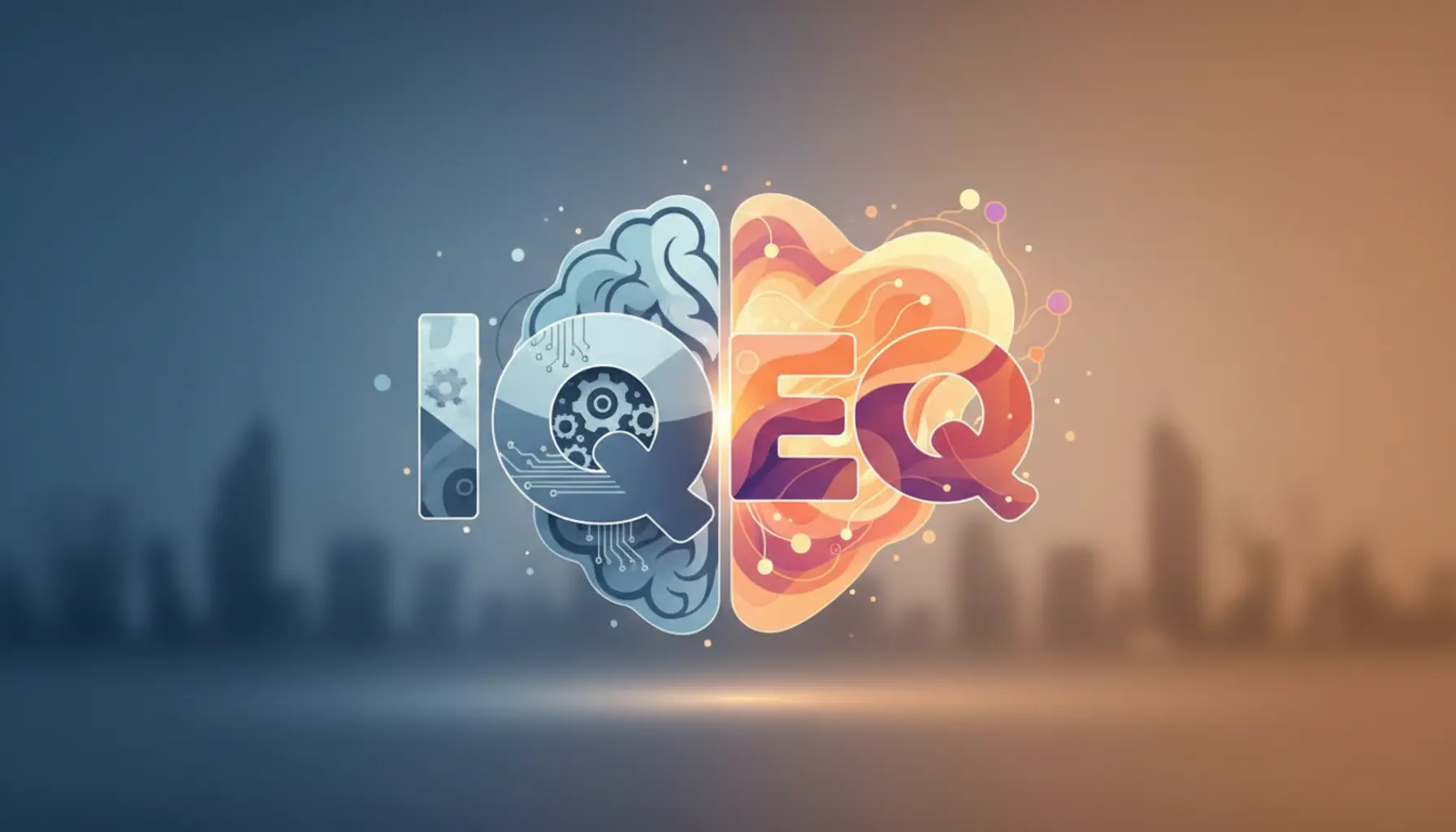
Although in everyday language EQ (emotional intelligence) and IQ (cognitive intelligence) are often thrown into the same bag under the term “being smart,” they actually describe completely different areas of human functioning — especially in the workplace. IQ mainly refers to analytical abilities, logical thinking, reasoning, understanding complex information, and solving problems in a “hard,” measurable way. IQ is traditionally measured by psychometric tests — such as intelligence tests, math problems, logic puzzles, or tasks requiring the rapid identification of patterns. A high IQ makes it easier to learn complicated subjects, program, work with data, or design strategies. EQ, on the other hand, deals with how we understand and regulate our own emotions, how we cope with stress, how we react to other people’s emotions, and how we build relationships. It’s a set of skills that determines how we use our knowledge and intellectual abilities in real-life work situations — especially when people, pressure, changes, and conflicts are involved. Emotional intelligence includes, among others, self-awareness (recognizing your own emotions, motives, strengths, and weaknesses), self-regulation (the ability to control impulses, maintain calm, flexibility), internal motivation (working in spite of obstacles), empathy (understanding others’ perspectives), and social competencies (communication, collaboration, leadership). In the simplest terms, IQ answers the question: “How quickly and well do you think?” and EQ: “How well do you understand yourself and others, and how do you cooperate with people?” From a business perspective, IQ can be seen as the “engine” — pure cognitive potential — while EQ is like the “control system” that decides where and how that engine is driven, how you handle the curves, and what you do when obstacles appear along the way. The difference is also crucial in terms of what is easier to change: IQ is largely biologically determined, and although it can be trained to a certain extent (for example, through learning, memory exercises, solving problems), it usually changes only slightly after adulthood. EQ, however, is much more plastic and susceptible to development — it can be systematically shaped through reflection, feedback, coaching, training, or social experience, making it a particularly valuable asset in a work environment that is constantly changing and requires adaptation. In practice, this means that two people with similar IQs can achieve completely different professional results depending on their EQ: one will manage time more effectively, remain calm under pressure, get along with a difficult client, or negotiate raises, while the other — despite high analytical abilities — may struggle with cooperation, motivation, or assertiveness. This is why, in recruitment, promotions, and development programs, companies are increasingly looking beyond “dry” substantive competencies, trying to understand how a candidate or employee functions emotionally and socially.
The differences between EQ and IQ become especially apparent when we look at specific workplace situations. Imagine a specialist with a very high IQ who prepares excellent analyses but cannot clearly communicate conclusions, reacts nervously to supervisors’ questions, and quickly gets into conflicts with the team — his cognitive potential does not fully translate into business value. Conversely, someone with slightly lower IQ but very high EQ can build a network of relationships, obtain stakeholder support, diffuse team tensions, motivate others to act, and effectively implement developed solutions. In this sense, IQ is more often associated with “what” you can do substantively, while EQ is “how” you use it in relationships and emotionally charged situations. IQ better predicts academic results and success with strictly cognitive tasks, while EQ is strongly correlated with the quality of leadership, job satisfaction, resilience to burnout, team loyalty, or effectiveness in managerial and sales roles. In office or corporate work, where cooperation, change, and complex communication are key, EQ’s advantage over IQ is increasingly evident. Importantly, EQ and IQ are not mutually exclusive — it’s not “either–or.” The greatest professional successes usually come from combining solid IQ with well-developed EQ. For organizations, this means a paradigm shift: instead of only asking, “can this person do the task?”, they increasingly ask, “how does this person react under pressure?”, “can they take feedback?”, “how do they cooperate with other departments?”, “do they inspire and engage the team?”. The EQ vs IQ difference is especially important in change management — IQ helps plan new structures, processes, and KPIs, but it’s the EQ of leaders and employees that determines whether the change will be accepted, whether people understand its purpose, and how they cope with fear and resistance. In this way, IQ creates solutions and EQ enables their implementation and maintenance in the real, “human” world of organizations. With the rise of automation and artificial intelligence, this difference becomes even more important: many tasks requiring purely logical information processing can be delegated to algorithms, while the ability to understand emotions, build trust, and influence people remains a human advantage — and that’s exactly the area addressed by emotional intelligence.
The Importance of EQ in the Workplace
Emotional intelligence in the workplace is no longer a “nice addition” but is becoming one of the key factors determining team effectiveness, employee satisfaction, and business results. In organizations with high change dynamics, pressure for results, and the need for rapid learning, intellectual ability alone is not enough — what increasingly determines who copes best is the ability to manage emotions, both their own and others’. An employee with developed EQ can recognize their moods, name emotional states, identify their causes and impact on behavior, which translates into greater professional awareness: better energy management, more realistic assessment of one’s capabilities, and constructive reaction to criticism. Instead of taking difficult information as a personal attack, they see it as an opportunity for development, can ask for clarification, specify expectations, and propose solutions. This attitude significantly reduces the number of conflicts resulting from misunderstandings and unclear assumptions, saving the company time and resources. EQ also affects how an employee deals with stress: instead of taking tension out on coworkers, they use healthy strategies to regulate emotions — taking a break, changing perspective, asking for support, prioritizing tasks. For the organization, this means fewer burnouts, lower turnover, and greater team resilience to crises, which directly translates into business stability. It’s worth noting that EQ is closely associated with the quality of workplace relationships. People with high emotional intelligence listen better, quickly pick up on nonverbal signs of tension or fatigue, and can adjust communication style to the conversation partner — they will talk differently to an introverted analyst than to a dynamic salesperson. This approach builds trust and a sense of psychological safety, which is the foundation for open exchange of ideas, feedback, and innovation. A team that trusts each other more willingly shares knowledge, admits mistakes, and asks for help instead of hiding problems until they become a serious threat. In such environments, it is easier to implement agile methods, run creative brainstorming sessions, and experiment with new solutions, which is crucial in creative, technological, or service industries.
EQ also plays a particularly large role at the leadership level. A leader with high emotional intelligence can build authority not only based on substantive knowledge or formal position but above all on the foundation of relationships and understanding people. They know their employees’ strengths, understand their motivations, concerns, and limitations, and thus can delegate tasks to use individual potential and simultaneously develop the entire team’s competencies. Instead of managing through fear or control, they focus on partnership communication: they clearly formulate expectations, provide specific feedback, respond to declining engagement before it becomes burnout. Such a leader does not avoid difficult conversations but conducts them in a way that minimizes defensiveness and maximizes the chance for understanding — they can name emotions in the team, reflect them, and at the same time remain focused on business goals. In practice, this means, for example, better change management: when introducing new procedures or tools, they consider not only the technical aspect but also people’s emotional reactions — fear of the unknown, frustration, a sense of lost control. Thanks to this, they can adjust communication, pace, and type of support to minimize resistance and increase readiness to implement novelties. Emotional intelligence also directly influences organizational culture. Where empathy, respect, the ability to listen, and sharing emotions in a mature way are promoted, phenomena such as mobbing, passive aggression, “office politics,” or silos are less likely to occur. Employees feel they are treated as individuals and that their psychological well-being is an important element of the company, which increases loyalty and engagement. This effect is particularly visible in hybrid and remote environments, where the lack of daily face-to-face contact makes it harder to notice subtle signs of tension or overload. People and teams with high EQ actively care for quality online meetings, allow space for “human” conversation, and check how others feel, not just the project’s status. Importantly, developing EQ is not reserved only for managers — it’s a cross-sectional competency that increases the value of every specialist: from programmers and salespeople to data analysts. In the age of automation and artificial intelligence, the ability to understand people, collaborate, build trust, and create a creativity-friendly environment is a major advantage machines can’t easily imitate. That’s why more organizations invest in self-awareness, emotion regulation, empathetic communication, and conflict resolution training, seeing EQ not as a “soft addition” but as a strategic asset with a real, measurable impact on business results, employer branding, and the long-term development of the company.
The Role of Emotional Intelligence in Management and Leadership
Modern management is less and less like the model based on hierarchy, control, and “hard” metrics, and is increasingly focused on people, their motivations, engagement, and sense of purpose. In this context, a leader’s emotional intelligence becomes one of the key factors of a competitive edge — not only on an individual, but above all, a team and organizational level. A leader with high EQ can consciously manage their own emotions, making them predictable, stable, and resilient to pressure, which in practice translates into greater trust in the team and better decision quality, especially in crisis situations. Instead of reacting impulsively to stress, failure, or others’ mistakes, they can pause, name what they feel (e.g. anger, frustration, helplessness), and then consciously choose how to act — e.g. reframe the problem, ask for a team member’s perspective instead of “dumping” emotions as attacks or passive aggression. This self-regulation means the team doesn’t live in constant emotional tension, doesn’t waste energy guessing the boss’s mood, but can focus on work, innovation, and development. Another pillar of EQ in leadership is self-awareness — emotionally intelligent leaders know their strengths, limitations, typical stress reactions, and can admit mistakes and take responsibility for decisions. Instead of building authority on “infallibility,” they build it on authenticity, which paradoxically strengthens their position. Employees are more willing to cooperate with someone who doesn’t pretend to be perfect but actually listens, accepts feedback, and grows with the team. High EQ also translates into communication style: a leader knows how to tailor the message to the audience, cares for clarity of expectations, and gives constructive feedback, separating behavior from the person’s value. In practice, this could mean discussing project difficulties in a concrete, calm, solution-oriented way, instead of offering generic criticism that hurts and demotivates. Emotional intelligence also influences decision-making — a leader who understands their own emotions is more aware of how fear, ambition, the need for acceptance, or perfectionism can distort an assessment. They know how to balance logic (IQ) and emotional intuition, using data but also clues coming from relationships, team atmosphere, or clients’ moods. Thanks to this, they are better able to assess real risks (e.g. burnout of key employees, talent drain, declining team loyalty), which often aren’t immediately visible in Excel spreadsheets, but are hugely important for long-term business results.
An important area where EQ translates directly to leadership quality is relationship and trust building in teams. Leaders with high emotional intelligence are attentive to nonverbal signals, tensions, and moods, and spot early signs of conflicts, demotivation, or frustration before they become serious problems. They can talk about emotions naturally and professionally — asking how team members feel with a decision, project, or change, without turning the discussion into “therapy,” but combining emotional sensitivity with responsibility for tangible outcomes. Well-developed empathy, one of the key components of EQ, allows leaders to see situations through employees’ eyes — understanding that a difficult reaction often stems not from “entitlement” but from fear, fatigue, or a sense of injustice. This makes it easier to choose the right leadership style: sometimes more supportive when navigating a crisis or major change, sometimes more task-oriented, when rapid mobilization is needed. In motivating employees, EQ allows leaders to go beyond universal patterns like “bonus for results” and understand what truly drives each person: for some, it’s opportunities for growth and learning, for others, a sense of influence, autonomy, recognition, safety, or work–life balance. A leader aware of these differences is able to design tasks, communicate goals, and give feedback in a way that strengthens intrinsic motivation, not just relying on “carrots and sticks.” Emotional intelligence is also vital in change management — during restructuring, mergers, new systems, or strategy implementation, people often experience fear, uncertainty, and resistance. Leaders with low EQ usually try to “push through” change with logic, ignoring the emotional side, which leads to hidden sabotage, lower engagement, or the departure of key staff. Leaders with high EQ plan change communication to answer not just “what?” and “how?”, but also “why?” and “what does it mean for me?”. They create space for questions, concerns, even criticism, treating them as a natural part of the process rather than a threat to authority. Also, EQ is visible in how leaders build feedback cultures: encouraging opinions, treating criticism as information, not a personal attack. They teach the team how to name emotions at work — e.g., frustration with chaotic processes or lack of influence on decisions — and translate these into actionable insights and improvements. This helps teams become emotionally mature, so inevitable conflicts don’t turn into silent wars or passive aggression, but become fuel for development. Lastly, a leader’s emotional intelligence directly shapes diversity and inclusion management — the ability to empathize with people of different work styles, backgrounds, ages, or temperaments enables the creation of environments where everyone can be themselves, contribute uniquely, and feel respected, boosting creativity, innovation, and organizational ability to adapt to a dynamic market.
Soft Skills — Your Advantage in the Job Market
In a world where more and more processes can be automated, and access to specialist knowledge is not a luxury but a norm, soft skills are starting to truly determine who gets noticed, promoted, and remains at the top of their profession. Competencies such as communication, empathy, assertiveness, teamwork, or adaptability to change are a direct manifestation of emotional intelligence (EQ) in on-the-job behavior. While IQ can help you more quickly understand procedures, analyses, or tools, it’s soft skills that let you use that knowledge in teams, with clients, and in dynamic, often unpredictable business situations. Employers are increasingly emphasizing that a lack of soft skills is one of the main reasons for recruitment failures — even when a candidate has an impressive CV, certificates, and technical experience. The difference between an average and outstanding specialist is rarely about who knows more tools or technologies, but who can listen effectively, understand others’ perspectives, de-escalate tensions, negotiate, and maintain long-term relationships. This is especially evident in roles focused on interdepartmental cooperation, project management, or client contact — where the ability to persuade, build trust, and quickly find footing in ambiguous situations counts. Importantly, employers are now often testing soft skills at the recruitment stage, using team tasks, assessment centers, case studies, or behavioral questions that reveal not just “what you know,” but “how you act and react” under time pressure, in opinion conflicts, or with incomplete data. In practice, it’s soft skills that determine how your EQ translates into results that matter to the organization: team turnover, project completion rates, client satisfaction, quality of collaboration with other departments. Even in highly technical jobs like programmer, data analyst, or engineer, the market increasingly favors people who, apart from “hard” expertise, can explain complex matters simply, accept feedback without defensiveness, and respond flexibly to changing business priorities. Today, soft skills are among the crucial differentiators, especially among specialists with similar education, experience, and technical skills — they determine who becomes the natural candidate to lead key projects, talk with strategic clients, or take on management positions.
The key soft skills, directly resulting from emotional intelligence and most influencing your job market advantage, include conscious communication, teamwork, self-management under stress, empathy, adaptability to change, responsibility, and proactivity. Conscious communication is not just about “speaking well,” but mainly about active listening and tailoring your message to your audience — different arguments will persuade the board, the IT team, or a client who is outside the industry and does not know specialist terminology. People with developed communication skills can clearly set expectations, ask clarifying questions, resolve misunderstandings before they become conflicts, and give feedback in a way that motivates instead of wounds. Teamwork is founded on trust, respect for diversity, and the willingness to share responsibility — in practice, this means, for example, admitting you don’t know something, asking for support, appreciating others’ contributions, and constructively expressing dissent when you have doubts about a team decision. Strongly valued today is the ability to manage yourself under stress: deadlines, unclear expectations, or sudden priority changes are the norm in most sectors, and those who maintain clarity of thought under pressure, don’t transfer emotions to coworkers, and seek solutions instead of blame, have the edge. Empathy, often confused with excessive compliance, is in reality the ability to understand what’s behind another person’s behavior — their fears, needs, or limitations — and respond in a way that takes these into account while protecting your own boundaries and business goals. Another skill closely related to EQ is adaptability to change: the ability to operate in new structures, tools, and work models (e.g., hybrid), without losing motivation and with a sense of agency rather than feeling like a victim of circumstances. Equally important are responsibility and proactivity — not waiting for someone else to notice a problem, but raising it yourself, proposing solutions, learning new skills before they become mandatory, not only in times of crisis. All these soft skills have a common denominator: the ability to understand oneself and others, regulate emotions, and consciously choose reactions instead of acting automatically on impulse. Importantly for your career, most of them can be systematically developed — through 360° feedback, training, coaching, but also daily self-reflection, observing your own reactions in difficult situations, and practicing new communication styles. As a result, soft skills become not only a “nice addition” to your CV, but real capital that translates into greater trust from supervisors and clients, better promotion opportunities, and greater resilience to labor market fluctuations, because EQ-based skills are much harder to replace with algorithms or automated procedures.
EQ and Professional Success: Studies and Examples
Although for years IQ was regarded as the main indicator of professional potential, more and more studies show that in real work environments, competencies stemming from emotional intelligence are equally — and in many roles, even more — important. Daniel Goleman, a popularizer of EQ, already in the 1990s indicated that up to 80% of leaders’ performance differences may stem from emotional, not strictly cognitive, skills. Newer analyses, including those by Harvard Business Review, TalentSmart, or Gallup, confirm this trend: employees with high EQ are more likely to achieve sales targets, excel in teamwork, and are less likely to burn out. TalentSmart research involving over a million people showed that 90% of top performers have high EQ, while among the lowest-performing, emotional intelligence is much less common. Crucially, this doesn’t mean that people with high EQ always have high IQ — it’s rather that, at similar levels of substantive skills, it’s EQ that “tips the scale” for certain specialists or managers. This translates directly to companies’ financial results: teams led by highly emotionally intelligent leaders are more engaged, have less turnover, and achieve strategic goals more often. In practice, this means lower recruitment costs, fewer conflicts, less absenteeism, and a better employer image. The link between EQ and success is particularly clear in relationship-based professions like sales, client service, HR, or project management. Salespeople with high EQ are better at recognizing clients’ real needs, sensing their fears, adjusting communication style and pace, and ultimately building lasting relationships that bring returning customers and referrals to the company. Project managers with developed empathy and self-awareness quickly spot “soft” risks — e.g., burnout among key team members, growing interdepartmental tensions, or declining motivation — and intervene before the issues escalate into costly delays or disputes. In HR, emotional intelligence allows for difficult conversations (e.g., about terminations, changes to employment conditions, or personal conflicts) in a way that minimizes feelings of unfairness or loss of trust in the firm. Gallup research on employee engagement shows that immediate supervisors have a key impact on decisions to stay or leave, which further highlights the role of managers’ EQ. High IQ without constructive communication skills, empathy, and emotional management often results in “cold” relationships, a sense of distance, and lack of identification with the team, which in turn reduces motivation and willingness to engage beyond the bare minimum required for the role. Notably, EQ is also linked with better adaptation to change — employees with high emotional intelligence not only cope with their own fears about the unknown more quickly but also support others, calming team tensions and turning uncertainty into curiosity and readiness to experiment. In organizations undergoing digital transformation, mergers, or restructuring, such people become natural “change agents,” blending business perspective with care for people. That’s why consulting firms (such as Korn Ferry, Deloitte) increasingly list emotional skills among key predictors of success in future managerial and expert roles.
Examples from real business life illustrate how EQ works in practice — often in situations where logic and analytics alone are not enough. Imagine two heads of sales departments with similar experience and analytical test results. The first is focused mainly on numbers and responds to declining results with pressure and control: more frequent reporting, late-night emails, public criticism. The second, with high EQ, spends time not just analyzing data, but talking to the team, trying to understand what’s behind a drop in motivation, what blocks salespeople in client contact, how the market has changed, and what emotions are associated with these challenges. In a few months, it is the second leader who is more likely to achieve lasting improvement, because he rebuilds trust, helps staff cope with stress, and supports them in building confidence with difficult clients. The same pattern can be observed among IT professionals — a field often seen as IQ-dominated. A programmer with high emotional intelligence can not only write good code, but also explain complex issues to non-technical people, take code review feedback without defensiveness, and take responsibility for mistakes rather than looking for scapegoats. As a result, they are more often invited to key projects and quickly shortlisted for promotion to team lead. In customer service, differences are even more pronounced: a consultant with high EQ doesn’t just solve technical problems but also manages the client’s emotions — naming their frustration, expressing understanding, maintaining a calm, kind tone even when the person on the other end is growing frustrated. Such an approach leads to higher client satisfaction, greater willingness to repurchase, and better NPS scores. Additionally, emotional intelligence helps in situations where what’s at stake is personal career advancement — like negotiating a raise or promotion. A person with high EQ prepares not only substantively (numbers, results, projects) but also emotionally: forecasting potential supervisor concerns, choosing the right moment, reading nonverbal cues closely, and in case of rejection, not reacting impulsively but asking for clarification and setting a clear date for a follow-up conversation. This builds the image of a professional who negotiates assertively but with respect, enhancing trust in him as a future leader. On an organizational scale, people with high emotional intelligence often become the “glue” connecting departments, diffusing inter-silo tension, and translating the language of one group (e.g., IT) into the language of another (e.g., sales). This leads to smoother project execution and better market adaptability, as the company is quick to exchange information and avoids destructive conflicts.
How to Develop Your Own Emotional Intelligence?
Developing emotional intelligence is not a matter of innate “people skills,” but a process that can be consciously shaped — much like technical or business competencies. The first pillar of EQ is self-awareness, or the ability to recognize and name your own emotions in real time. In practice, this means pausing for a moment in a difficult situation and asking yourself: “What exactly am I feeling now?”, “What triggered this reaction?”, “How is this affecting my decisions?”. A helpful tool is an emotion journal — brief notes taken after important meetings or stressful situations, where you write down what happened, how you felt, how you reacted, and what you might do differently next time. Such systematic reflection increases awareness of your own emotional patterns, e.g., a tendency toward defensiveness with criticism or decision paralysis in conflict. Developing self-awareness can also be supported with simple mindfulness exercises — e.g., 3–5 minutes of daily conscious breathing, noticing body sensations and thoughts without judgment. Regular practice makes it easier to spot the first signs of tension (e.g., fast heartbeat, tense shoulders) before emotions take control. The second key element of emotional intelligence is self-regulation — the ability to manage your reactions rather than respond impulsively. At work, this means, for example, delaying a reply to a tough email when you feel anger, or asking to pause a difficult conversation rather than escalating conflict. The “emotional pause” technique helps here: a short break between stimulus (e.g., a manager’s harsh comment) and response. Technically, it might look like this: 3 slow breaths, counting to 10 in your head, a brief focus on your body (feet, breath), and only then responding. Self-regulation is also supported by working on beliefs — e.g., instead of thinking “he’s attacking me,” try interpreting the situation as “he’s under great pressure and trying to protect his project.” It’s not about excusing others’ behavior, but choosing an interpretation that helps keep control over your own actions. EQ development also includes building psychological resilience, which aids in handling stress and setbacks — helpful here are regeneration habits (sleep, physical activity, digital hygiene), assertively setting boundaries at work (e.g., “No work messages after 7:00 PM”), and consciously planning work in blocks to minimize chaos. Personal values are a solid foundation for emotional intelligence — knowing what’s important to you at work (e.g., growth, security, autonomy, collaboration) helps make decisions aligned with yourself and reduces inner emotional conflict.
The second pillar of EQ is social competence: empathy, communication, and relationship-building skills. Practical empathy is not “understanding and agreeing with everyone”, but a consistent exercise in seeing the other’s perspective. Instead of automatically judging a coworker’s behavior (“he’s unprofessional”), it’s worth asking yourself and them: “What might be behind his reaction?”, “How does he see the situation?”, “What are his fears or needs?” In conversations, paraphrasing and reflecting emotions is helpful, e.g.: “I understand you’re frustrated because the deadline was unrealistic” instead of “Stop being upset.” This style doesn’t mean agreeing to everything, but signals to the other person that they’ve been heard — which lowers tension and facilitates solutions. To build empathy and communication skills, practice active listening: ask open-ended questions, refrain from interrupting, and summarize key points of the conversation. At work, the ability to give and receive feedback in a way that supports growth, not wounds, is especially important. Here, simple frameworks help, e.g., FUKO (Fact–Feelings–Consequences–Expectations) or SBI (Situation–Behavior–Impact), which focus on behaviors, not judging the person. Developing emotional intelligence also means building social awareness — attentiveness to team dynamics, reading others’ nonverbal signals (face, voice tone, body posture), spotting tension before it becomes open conflict. You can practice this, for instance, in meetings: notice who participates, who is silent, who interrupts, at which points group energy drops. Finally, EQ grows with intentional feedback and challenging experiences: ask coworkers and supervisors for honest feedback on your communication, stress reaction, or meeting faciliatation. Instead of resisting criticism, treat it as calibration data — a clue how you are being perceived and what you can modify. It may help to create a simple, 3–6-month EQ development plan: pick two to three habits (e.g., “in every meeting, I’ll summarize at least once what I’ve heard;” “before sending a tough email, I’ll take three deep breaths and write two versions of my response”), monitor implementation, and reflect regularly: what’s working, what’s not, what could change. Growing emotional intelligence is a long-term process — it requires attentiveness, practice, and a willingness to confront your own patterns, but gradually becomes second nature, directly improving cooperation, decisions, and job satisfaction.
Summary
Emotional intelligence (EQ) is increasingly recognized as a key factor for success at work and in management. Understanding the differences between EQ and IQ helps you better manage yourself and others, build stronger relationships, and achieve higher professional results. By developing soft skills — such as empathy, communication, or emotional management — we become valued employees and leaders. These qualities are now the deciding factor for competitive advantage in the job market and leadership roles within teams.


