Abdominal Exercises
Dreaming of a flat, chiseled stomach is one of the most common training goals. The famous “six-pack” is a symbol of fitness and an attractive figure. However, strong abdominal muscles are much more than just aesthetics. It is the foundation of a healthy spine, correct posture and overall functional strength.
Spis treści
Why Are Strong Abdominal Muscles So Important for Your Health?
Before we get into specific exercises, it’s worth understanding why working on your abdominal muscles is an investment in your health, not just your appearance. These muscles, which are part of the so-called “core”, perform key functions:
- Spinal stabilization: A strong abdomen acts as a natural corset that stabilizes the lumbar spine, reducing the risk of back pain and injury, which is crucial in the context of exercise intensity.
- Improving Posture: crucial for effective abdominal muscle training. Weakened abdominal muscles often lead to deepened lumbar lordosis (excessive bending of the back), which results in a hunched posture.
- Support for Internal Organs: The abdominal muscles hold the internal organs in place.
- Force Transfer: They provide an energy bridge between the upper and lower body, which is crucial in almost every sport – from running to weightlifting, as well as standing abdominal exercises.
- Better balance: A strong “core” means better balance and motor coordination.
Anatomy of the abdominal muscles – know your opponent
For training to be effective, you need to know what you are training. The abdominal wall is made up of several layers of muscles, each with a different function.
rectus abdominis muscle (rectus abdominis)
It is this muscle that is responsible for the desired “six-pack” and reduction of belly fat. It runs vertically from the sternum to the pubic bone, which is important in the context of the level of adipose tissue. Its main function is to bend the torso forward (like when doing crunches).
External and Internal Oblique Muscles (Obliquus Externus & Internus Abdominis)
They are located on the sides of the rectus muscle. They are responsible for torso twists and lateral flexions. They shape the waist and are responsible for the so-called abdominal muscle exercises. “sides”. Working on them is crucial for a full, three-dimensional appearance of the abdomen.
Transverse abdominis muscle (transversus abdominis)
It is the deepest abdominal muscle that is crucial in the best muscle exercises. It plays the role of the aforementioned natural corset. You can’t see it, but its strength is absolutely fundamental for the stability and flat appearance of the abdomen. You activate it by trying to “pull your belly button towards your spine”, which will help you exercise your abs.
The Most Effective Exercises for a Flat Stomach and a Strong Core
Below you will find a list of proven and effective abdominal exercises at home, divided into categories according to the main muscle part involved. Remember about the precision of movement – quality is more important than quantity!
Upper Abdominal Exercises
- Classic abdominal crunches
- Starting position for abdominal training at home: Lie on your back, bend your knees, and place your feet flat on the floor. Place your hands gently behind your ears or cross them over your chest. Do not braid them behind your head to avoid pulling on your neck while doing abdominal exercises at home.
- Movement: a key element in doing exercises for the abdomen and sides. As you tighten your abdominal muscles, lift your upper back and shoulders off the floor. The lumbar spine remains in contact with the mat. Focus on “curling” the chest towards the pelvis. At the peak of tension, stop the movement for a second and then slowly lower your torso.
- Allahy / Abdominal Tightening with Upper Pulley Cord
- Starting position: Kneel facing the upper pulley. Grab the end of the rope with both hands and pull it to your chest, at the height of your collarbones.
- Traffic: Bend your torso forward, concentrating on the strong contraction of your abdominal muscles, as if you wanted to touch your elbows to your knees. Keep your hips still. Slowly return to the starting position, controlling the tension.
Lower Abdominal Exercises
- Lying Leg Raises
- Starting position: Lie flat on your back with your legs straight to prepare for beginner abdominal exercises. You can slide your hands under your buttocks to stabilize your pelvis and prevent your lumbar region from detaching from the ground.
- Traffic: Keeping your legs straight (or slightly bent for ease), slowly lift them up until they are perpendicular to the floor. Then, even more slowly, lower them, stopping the movement just above the ground. The key is constant control and tension of the abdomen.
- Flutter Kicks
- Starting position: Similar to leg raises. Lift your head and shoulders slightly to further engage your upper abdomen.
- Traffic: Lift your legs a few centimeters off the floor. Perform quick, alternating, small up-and-down movements, imitating the work of scissors, to strengthen your abdominal muscles at home.
Oblique Muscle Exercises (Sides)
- Bicycle Crunches
- Starting position: Lie on your back, hands behind your ears, to prepare for the best abdominal exercises. Lift your legs and bend them at the knees at a 90-degree angle. Lift your shoulders and head off the floor.
- Traffic: Alternate the motion, pulling your right knee to your left elbow while straightening your left leg. Then smoothly change sides – left knee to right elbow. Traffic should be smooth and controlled.
- Sit Torso Twist (Russian Twist)
- Starting position: Sit on the floor, bend your knees, and lift your feet slightly off the ground, which can be part of the abdominal exercise. Tilt your torso back until you feel the tension in your abdominal muscles, keeping your back straight. You can hold a weight (kettlebell, dumbbell) in your hands to make it more difficult.
- Traffic: Perform controlled torso twists with the weight, trying to touch the floor once on one side and once on the other in an abdominal workout.
Core Exercises
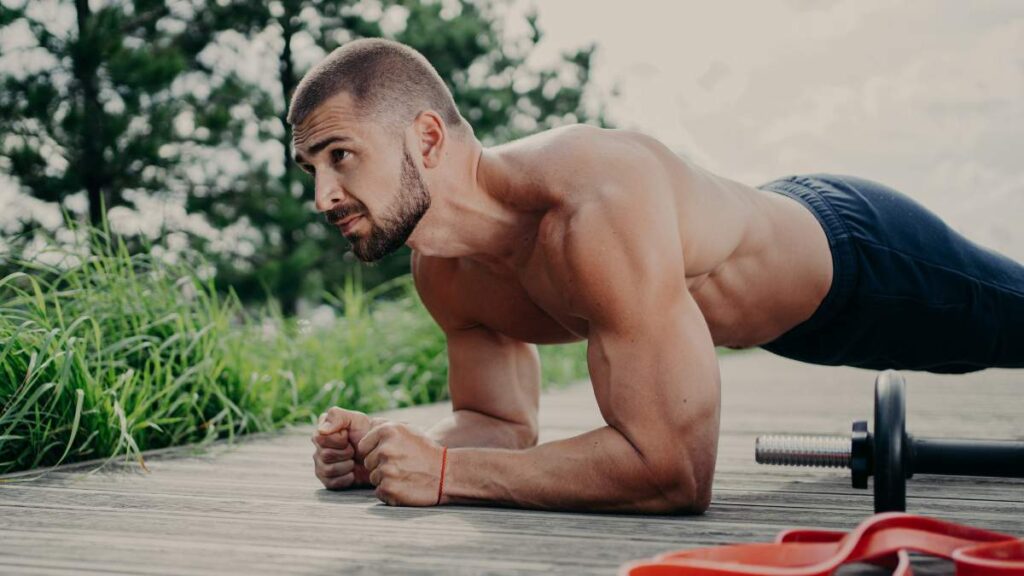
- Plank
- Starting position: Get into a push-up position, but lean on your forearms. The elbows should be exactly under the shoulders.
- Traffic: Hold the position by creating a single, straight line from your head to your heels. Tighten your abdominal and buttocks muscles firmly. Don’t let your hips sink or lift them too high. Hold this position for a certain amount of time (e.g. 30-60 seconds).
- Dead Bug
- Starting position: Lie on your back. Raise your arms straight toward the ceiling. Bend your legs at the knees and hips at a 90-degree angle (the so-called oblique abdominal exercises). chair position). Press your lumbar region against the floor.
- Traffic: Slowly and simultaneously lower your right arm and left leg toward the floor to increase the intensity of your abdominal exercises. Stop the movement just above the ground, all the while controlling the tension of the abdomen. Return to the starting position and repeat to the other side (left arm and right leg).
How to Build an Effective Abdominal Training Plan?
The key to success is regularity and progression in abdominal training. You don’t have to train your abdomen every day to effectively strengthen your muscles. Muscles, like any other, need time to recover from an intense abdominal muscle workout. The optimal frequency is 2-4 sessions per week.
Sample Training Plan for Beginners (2-3 times a week)
- Plank: 3 sets of 30 seconds
- Abdominal crunches: 3 sets of 15 repetitions as part of an intense abdominal workout.
- Lying leg raises (knees bent): 3 sets of 12 reps
- Rest between sets: 45-60 seconds.
Sample Intermediate Training Plan (3-4 times a week)
- Hanging leg raises: 3 sets of 10-12 reps
- Bike: 3 sets of 45 seconds
- Weighted Torso Twists (Russian Twist): 3 sets of 20 reps (10 per side)
- Allahy on the pulley: 3 sets of 15 reps
- Rest between sets: 30-45 seconds.
Flat Stomach Diet – 80% Success
You can do the best abdominal exercises, but if your muscles are covered in a layer of body fat, you’ll never see them. The truth is brutal: the belly is made in the kitchen.
- Caloric deficit: To burn body fat, you need to consume fewer calories than you burn. This is an absolute must.
- Protein: Increase your protein intake (lean meat, fish, eggs, dairy, legumes). It provides satiety, protects muscles during reduction and has a high thermal effect.
- Complex carbohydrates: Choose wholegrain products (groats, brown rice, wholemeal bread) that provide energy and fiber.
- Healthy fats: Avocados, nuts, seeds, and olive oil are essential for hormone function.
- Avoid: Simple sugars (sweets, sweetened drinks), highly processed foods and excess alcohol, which can affect body fat levels. They cause insulin spikes and promote fat accumulation in the abdominal area.
- Hydration: Drink plenty of water. We often confuse thirst with hunger.
The most common mistakes when exercising for the abdomen – avoid them!
- Pulling the head with the hands: In crunches and tenses, which strains the cervical spine. The movement is supposed to come out of the strength of the abdominal muscles.
- Moving too fast: Swinging your legs or torso without control. It is the momentum, not the force, that does the work. Focus on the eccentric phase (lowering) in doing abdominal and side exercises.
- Breath Holding: Proper breathing is crucial. Exhale during the tightest phase and inhale during the relaxation phase of your abdominal workout.
- Arching Your Back: Especially during leg raises. If you are unable to support your lumbar region on the mat, make the exercise easier (e.g. by bending your knees).
- Ignoring deep muscles: Focusing only on the “six-pack” is a mistake. A strong transverse muscle is the basis for stability and a flat stomach.
Summary
The road to a flat and strong stomach is a marathon, not a sprint. It requires a combination of three pillars: intelligent training, a balanced diet and consistency. Remember to listen to your body, take care of your technique, and increase your challenges regularly. By following the advice in this guide, you are on your way to achieving your goal and enjoying not only great looks, but above all better health and fitness.