Prostate Specific Antigen (PSA)
Discover PSA reference values, the importance of testing, and how to interpret your results. Learn how to prepare for a PSA test and how to regularly monitor prostate health.
Table of Contents
- What is PSA and why should you test for it?
- PSA standards in blood – ranges for different age groups
- PSA Tests – total and free: what do these measurements entail?
- Elevated PSA – most common causes
- How to prepare for a PSA test?
- The importance of regular PSA testing in prostate cancer prevention
What is PSA and why should you test for it?
PSA, or prostate-specific antigen, is a protein mainly produced by the cells of the prostate gland. Its presence is detected primarily in men’s blood. Measuring PSA levels is currently one of the most important diagnostic tools in assessing prostate health, especially in detecting oncological diseases and other disorders of this organ.
PSA – what exactly is it?
PSA plays a significant role in the body, as it is involved in liquefying semen, which is important for male fertility. Under normal conditions, PSA passes into the blood in only small amounts. Its level, however, may increase in various medical conditions, such as benign prostate hyperplasia, prostatitis, or prostate cancer.
An important feature of PSA as a marker is its tissue specificity, not cancer specificity. This means that both benign and malignant prostate conditions can affect PSA levels in the blood. Therefore, this test serves as the first signal that more detailed diagnostic tests may be needed.
Why is it worth regularly checking PSA levels?
PSA has become particularly valuable in prevention and diagnosis of prostate cancer, which is one of the most common malignant tumors in men. Early detection of even minor prostate changes significantly increases the chances of effective treatment and reduces the need for more invasive therapeutic methods.
Regular PSA testing is recommended especially for men over 50 years old, and when there is a family history of prostate cancer – starting as early as age 40. Early detection of deviations from the norm enables preventive action, proper diagnostics, and quick initiation of treatment.
Not only cancer – other uses of the PSA test
The PSA test is invaluable not only for prostate cancer diagnostics. It also helps detect benign prostatic hyperplasia (BPH), a very common issue among older men. PSA analysis may additionally reveal inflammatory conditions such as prostatitis, which require a different therapeutic approach.
PSA monitoring is also important for assessing treatment effectiveness – both after surgery and during pharmacological therapy. Drops or rises in PSA values allow the physician to determine whether the chosen treatment is producing the desired effects.
Why shouldn’t you ignore a PSA test?
Despite certain limitations in the interpretation of results, PSA testing remains one of the key tools in men’s health prevention. It not only enables early detection of serious diseases but also the exclusion or confirmation of benign prostate conditions. Awareness of PSA’s importance and regular monitoring of this protein are an investment in every man’s health and quality of life.
PSA standards in blood – ranges for different age groups
Measuring PSA (prostate-specific antigen) concentration is one of the main diagnostic tools used in assessing prostate health. However, it is important to remember that PSA norms are not universal – the reference range considered normal changes depending on the patient’s age. Understanding these relationships is crucial for proper interpretation and preventing unnecessary anxiety over minor deviations.
Standard PSA ranges by age
PSA levels naturally rise with age. This creates a situation where a value seen as normal in a young man may signal the need for further diagnosis, while for an older patient it is typical and unremarkable. The most commonly used PSA reference ranges are as follows:
- Men aged 40–49 years: normal is a PSA concentration ≤ 2.5 ng/ml
- Men aged 50–59 years: normal is a PSA concentration ≤ 3.5 ng/ml
- Men aged 60–69 years: normal is a PSA concentration ≤ 4.5 ng/ml
- Men over 70 years old: normal is a PSA concentration ≤ 6.5 ng/ml
It is important to note that the above standards may differ slightly depending on the laboratory and local guidelines. Thus, results should always be interpreted by a physician who takes into account age and other individual risk factors.
Individual factors affecting PSA norms
Besides age, there are several other factors that can influence physiological PSA levels. These include:
- Prostate volume – a larger prostate, often observed in older men, produces more PSA.
- Race and genetic predisposition – certain populations and those with a family history of prostate cancer may have higher PSA values.
- Infections or inflammation – temporary increases in PSA can be linked to prostatitis or urinary tract infection.
When should elevated PSA cause concern?
Mildly elevated PSA values are relatively common and do not always indicate a serious disease. Special caution is needed when concentrations exceed age-specific reference ranges, and especially if PSA increases in subsequent tests or alarming symptoms appear such as urinary difficulties or perineal pain. The so-called PSA density index (the ratio of PSA to prostate volume), and the rate of PSA increase over time are also important factors.
Any deviations from the norm require urological consultation. The physician, based on the complete clinical picture, will decide on further diagnostic steps. Regular PSA monitoring enables early detection of prostate disorders and starting therapy when it is most effective. To read more about prostate health, see the article Prostate.
PSA Tests – total and free: what do these measurements entail?
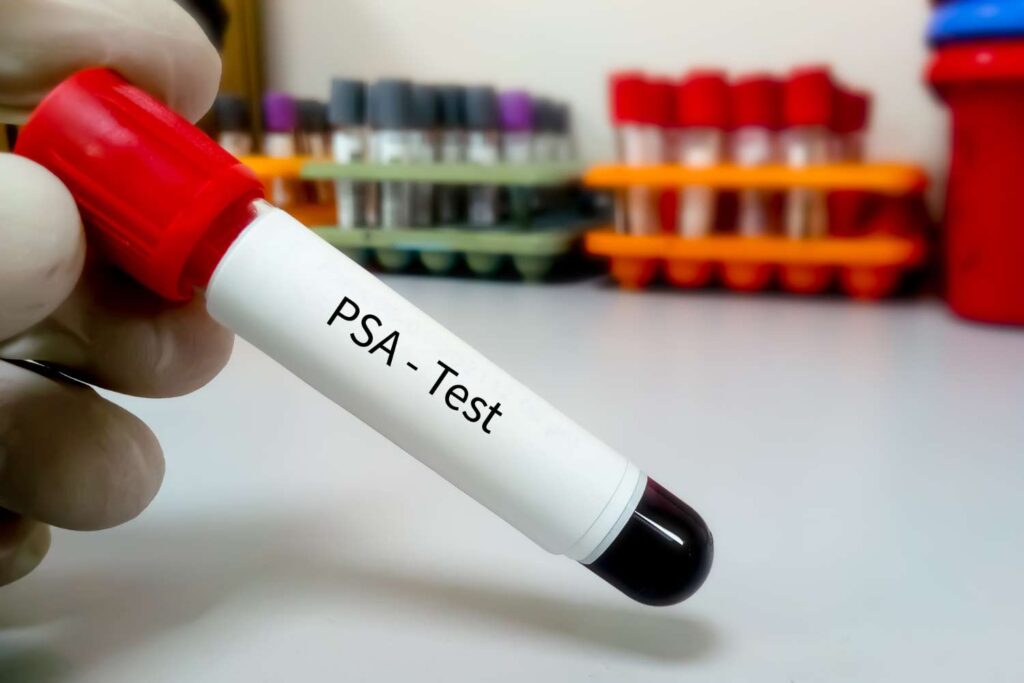
PSA testing is one of the most important tools for diagnosing prostate diseases. In laboratory practice, two main measurements are distinguished: total PSA and free PSA. Each provides different information on prostate functioning and can be used for more precise result interpretation.
What is total PSA?
Total PSA refers to the sum of two fractions: free PSA and PSA bound to plasma proteins, mainly alpha1-antichymotrypsin. In clinical practice, total PSA concentration is most often tested as the first step in screening for prostate cancer, benign prostatic hyperplasia (BPH), or inflammation. A total PSA result enables assessment of whether there are any abnormalities requiring further diagnosis.
An increased total PSA level does not necessarily indicate prostate cancer. It can be caused by benign processes such as prostate enlargement, urinary tract infections, or even intense physical activity or sexual intercourse before the test. For this reason, total PSA results should not be interpreted in isolation from other factors or the medical interview.
Free PSA – when is it measured?
Free PSA is the fraction of prostate-specific antigen that circulates in the blood unbound to other proteins. Free PSA is most often measured as a follow-up for men with elevated or ambiguous total PSA values (typically 4–10 ng/ml, the so-called “gray zone”). Analyzing the ratio of free to total PSA (fPSA/tPSA index) helps distinguish benign prostate changes from potentially malignant cancerous processes.
The ratio of free PSA to total PSA is an important diagnostic indicator. When the free PSA proportion is low (< 15%), suspicion of prostate cancer increases and further diagnosis, including prostate biopsy, is advisable. With a higher ratio (over 25%), the likelihood of cancer is low and the changes are more likely to be benign or inflammatory.
Why do both tests complement each other?
The combination of total and free PSA measurements offers greater diagnostic possibilities than measuring a single marker. This way, the doctor can more precisely assess cancer risk, decide on further diagnostic steps, and reduce unnecessary biopsies. For patients with slight total PSA elevations, analyzing the free/total ratio is an extremely valuable supporting tool.
Both tests are performed from a single venous blood sample. Before sample collection, adhere to your doctor’s recommendations, such as avoiding ejaculation or strenuous effort for 48 hours to avoid skewed results. In practice, the decision to test both fractions is made by the physician, based on age, risk factors, and individual history.
Elevated PSA – most common causes
Elevated PSA in the blood often causes anxiety because it is associated with prostate cancer. However, there are many other causes that can increase PSA values. Understanding them helps with better result interpretation and avoiding unnecessary stress.
Prostate cancer
Prostate cancer is one of the most common causes of persistent and clear PSA elevation, particularly in men over 50. Prostate cancer cells produce much more PSA than healthy tissue, causing an increase in blood levels. Still, not every case of high PSA means cancer – further diagnostics such as biopsy or ultrasound imaging are therefore necessary.
Benign prostatic hyperplasia (BPH)
One of the most common non-cancerous causes of elevated PSA is benign prostatic hyperplasia (BPH). With increased prostate volume, more cells produce PSA, resulting in a higher blood level. BPH is typical for men over 50 and is often linked with urinary problems, but is not oncologically dangerous.
Prostatitis
Inflammatory conditions of the prostate, called prostatitis, can significantly elevate PSA levels. Bacterial infection or chronic inflammation leads to prostate tissue damage, causing more PSA release into the bloodstream. In such cases, additional symptoms often include perineal pain, fever, or urination problems.
Procedural and traumatic factors
PSA levels can also increase after recent urological examination, such as digital rectal examination, prostate biopsy, cystoscopy, or other procedures affecting the gland. Cycling, running, or ejaculation within 24–48 hours of the test can also temporarily raise PSA. These situations usually cause a benign, transient PSA increase.
Other causes
Certain medications, metabolic disorders, kidney failure, or pelvic surgeries can raise PSA levels. Age and genetic predisposition also influence this antigen. Even minor urinary infections can cause temporary PSA elevations.
Interpreting elevated PSA always requires clinical context, medical history, and accompanying symptoms. Proper diagnostics can distinguish benign changes from serious prostate disorders and avoid unnecessary invasive procedures.
How to prepare for a PSA test?
Why is proper preparation important?
Correct preparation for PSA testing is key for obtaining reliable results. Many factors unrelated to prostate disease can cause a temporary PSA rise. Following recommendations minimizes the risk of falsely elevated values and reduces the need for repeat or otherwise unnecessary diagnostics.
Key rules before a PSA blood draw
Before a PSA test, pay attention to some important aspects that can greatly impact your result:
- Avoid ejaculation and sexual activity: Abstain from sexual activity, including ejaculation, for at least 48 hours before the test. Sexual activity can temporarily boost PSA.
- Limit intensive exercise: Exclude activities that could put pressure on the prostate, such as cycling, motorcycling, or vigorous workouts in the days leading up to your test.
- Report recent urological procedures: Catheterization, prostate biopsy, digital rectal exam (DRE), or cystoscopy within days or weeks before the test can temporarily increase PSA. Inform your physician if these occurred.
- Avoid urinary tract infections: Acute infections, especially those involving the urinary tract or prostate, can significantly raise PSA. If you have symptoms such as fever, pain, or burning while urinating, postpone the test until recovery.
- Inform about medications used: Some preparations, such as 5-alpha reductase inhibitors (given for prostate enlargement treatment), may lower PSA and affect interpretation.
Rules for blood collection for PSA
Blood for PSA testing is usually taken in the morning, on an empty stomach or after a light breakfast. Ideally, allow at least 8 hours after the last meal to exclude food’s effect on results. Staying hydrated is important – drink a glass of water an hour before your test but avoid caffeine or alcohol this day.
The patient should inform medical staff of any recent procedures, injuries, infection symptoms, and medications being taken. This helps the physician interpret the result properly and, when necessary, plan further diagnostic or monitoring steps.
What to do after the test?
No special precautions are required after blood collection – you may resume everyday activities. PSA test results are usually available the same or next working day. For abnormal values, consult a urologist who will consider all information provided during preparation, as well as any additional prostate symptoms.
The importance of regular PSA testing in prostate cancer prevention
Regular PSA testing is a key element in the prevention of prostate cancer, one of the most common malignant tumors among men. Early detection of abnormalities in PSA levels significantly increases the chances for effective therapy and high quality of life. For this reason, systematic PSA monitoring should be a permanent health care component for every man over 50 – and earlier for those with a family history of prostate cancer.
Early detection and treatment efficacy
One of the greatest challenges regarding prostate cancer is its long asymptomatic phase. In its early stages, the cancer typically causes no obvious symptoms, which often delays diagnosis until a more advanced stage. Regular PSA measurements enable the detection of abnormalities in the earliest stages, before symptoms appear. The earlier the recognition, the greater the opportunity to apply effective and less burdensome therapy, such as prostate-sparing surgery or modern radiotherapy. This increases the chance of full recovery and reduces the risk of complications or recurrence.
Decreased mortality thanks to screening
Screening with PSA testing has played an important role in the reduction of prostate cancer mortality in recent decades. In countries with regular prevention and education programs, earlier diagnoses and improved prognosis are observed. Although not every case of elevated PSA is cancer, this should not discourage men from testing – its purpose is to identify those at highest risk and refer them for further diagnostics.
Individualization of testing frequency
Testing frequency should always be set individually with your doctor, depending on age, general health, family history, race, and previous results. Guidelines recommend the first PSA measurement around age 50, and for risk groups as early as 40. Follow-up testing might take place every 1–2 years, but those with abnormal or borderline values should remain under constant specialist care.
The role of health education and male awareness
Increasing men’s awareness of the PSA test and early prostate cancer diagnostics is a key aspect of effective prevention. Health education provided by doctors, media, and public campaigns encourages men to break down barriers and regularly monitor their health status. Early diagnostics offer real chances for long-lasting, high-quality life without the burdens of advanced malignancies.
Summary
The PSA test is one of the essential tools in diagnosing and preventing prostate cancer. Understanding PSA standards and proper interpretation of the results enables more effective health maintenance. Regular testing, awareness of PSA-influencing factors, and proper test preparation help in detecting possible abnormalities early. By following testing frequency recommendations, you can effectively monitor prostate health and prevent serious diseases.