
Find out how, as a father, you can support your child’s development through empathetic parenting, building trust and emotional bonds, and using modern educational methods. See how practical rules and mindful presence shape a child’s healthy growth.
Learn how to build a strong father-child relationship. Discover empathetic parenting methods, emotional support, and practical principles of fatherhood.
Table of Contents
- The role of a father in a child’s life – why is it so important?
- How to build an emotional bond and trust
- Parenting methods based on empathy and non-violence
- Challenges in the father-child relationship – boundaries and consequences
- Supporting the child’s development and independence
- 10 practical rules of good fatherhood
The role of a father in a child’s life – why is it so important?
The father’s role in a child’s life was, until recently, mostly seen in terms of material responsibilities – a father was to “provide for the family” and “put a roof over their heads.” Modern psychological and neurobiological research, however, shows clearly that the presence and engagement of a dad have a crucial impact on the emotional, social, and cognitive development of a child. A father is one of the child’s first “mirrors,” teaching them to recognize their own emotions, boundaries, and abilities. The way a father reacts to the child’s crying, joy, anger, or fear affects how the young one will treat themselves and others in the future. A sensitive, attentive father teaches that emotions matter and can be discussed without shame. A child who receives empathy, a respectful touch, interest, and stable presence from their dad internalizes the conviction: “I am important, I am allowed to feel, I am allowed to ask for help.” This becomes the foundation for healthy self-esteem, which cannot be replaced by any material things or school successes. Moreover, for many children, dad is the first model of masculinity – they learn from him that being a man doesn’t have to be about toughness at all costs, bottling up emotions, or dominating, but can be based on respect, responsibility, and tenderness. For girls, dad may be the first man to show what quality of relationship they can expect as adults: whether someone will listen to them, recognize their boundaries and needs, or rather ignore them. Boys, on the other hand, learn from their father that one can be both strong and sensitive, that apologizing does not take away from masculinity, and showing emotions is nothing to be ashamed of. Such examples later affect their choices in relationships, friendships, and as future fathers themselves.
What matters is not just the father’s presence, but above all the quality of this presence. Children perfectly sense whether their father is genuinely engaged or just “serving his time” out of duty. Shared time – even if less than with the mother – can have enormous power if filled with authentic connection: conversation, play, laughter, hugging, cooking together, or fixing a bike. In these moments, the child learns trust in the world, experiments, makes mistakes, and with a father who responds with calm and support rather than criticism or violence, gains the courage to try new things. It’s often the dad who encourages a child to face challenges, sets reasonable boundaries, teaches coping with frustration and the consequences of choices. Instead of yelling “stop crying” or “pull yourself together,” he can name the child’s emotions (“I see you’re disappointed,” “that really could have scared you”), which is one of the key elements of non-violent parenting. Such an attitude does not weaken authority – quite the opposite, it builds it up in a solid and healthy way. For a child, the father is also a bridge to the outside world: he supports in peer relations, demonstrates fair play, teaches conflict resolution without aggression, respect for others’ boundaries, and assertively saying “no.” An engaged dad not only supports social development but has a real impact on cognitive development – studies show that children whose fathers talk with them a lot, read, explain the world, and answer questions, tend to have better concentration, greater curiosity about the world, and a richer vocabulary. Importantly, the father’s role matters at every stage – from the first months of life, when his touch and voice help regulate the child’s nervous system, through preschool and school years, up to the turbulent teenage years when adolescents especially need an adult who does not judge, but accompanies and can set clear yet kind boundaries. Modern fatherhood is shifting away from the “harsh judge” or “absent provider” model toward partnership, authentic closeness, and dialogue-based parenting. This change benefits not only children – many men find that engaged fatherhood gives their life deeper meaning, helps them understand their own emotions better, and heals wounds from their own childhoods which often lacked a gentle, available father. This way, they break away from violent, shouting, humiliating, or emotionally cold patterns, and their children grow up with a sense of safety, respect, and love, which become their natural reference point for life.
How to build an emotional bond and trust
An emotional bond between father and child does not appear overnight – it is born from hundreds of little moments in which the child sees they are important, noticed, and safe. Crucial here is the quality of presence: it’s not just about “being home,” but about truly being available – with the phone set aside, eyes on the child, ready to listen and respond. Even if you have little time, you can still build a bond if these short moments are filled with mindfulness: shared dinner, bedtime, stroll to preschool or school, or evening chats before sleep. Children quickly sense if a father is engaged or just “physically present,” so it makes sense to create small closeness rituals – a hug hello and goodbye, a secret handshake, “high fives,” or a daily question: “What was the most fun and what was the hardest today?” Such repetitive gestures give the child a sense of predictability and security, and for older kids – a message that dad really wants to know what matters to them. Trust is also built through respecting the child’s boundaries: allowing them to express dissent, say “no,” show anger or sadness without being punished or shamed. When instead of “Stop whining” the child hears: “I see you’re very sad, can you tell me more about it?”, they get the message that their inner world matters. That’s the foundation of non-violent parenting – both emotional and physical – where the dad doesn’t have to be “tough” to be an authority; he can be firm and gentle at the same time. Predictable reaction is also important: if today you calmly respond when the child makes a mistake, but tomorrow you yell for the same thing, the child starts to live in stress and fear rather than trust. Consistency doesn’t mean inflexibility, but coherence: what you say agrees with what you do. Children learn relationships by imitation – if they see you apologize when you shout, explain your mistake, and take responsibility (“I’m sorry, I raised my voice because I was tired, but it’s not your fault”), they learn that relationship can be repaired and tensions don’t cancel love. To build a bond, it’s also key to follow the child’s world: take interest in what genuinely fascinates them, even if for you it seems trivial – blocks, computer games, favorite shows, music, or sports. Instead of criticism (“That game is all nonsense”), choose curiosity (“Show me what’s interesting about this, what do you like in it?”) – the child feels important, and the father gains access to their inner world. Play together, mess around, joke, wrestle on the floor, build with blocks or cook together – those are not “a waste of time,” but the natural language in which the child builds connection, regulates emotions, and learns that the adult is on their side. Physical contact adjusted to age and comfort (hugging, stroking the head, piggyback rides, high fives) calms the nervous system, reduces stress, and strengthens a sense of security – as long as it is always voluntary and respectful, never forced.
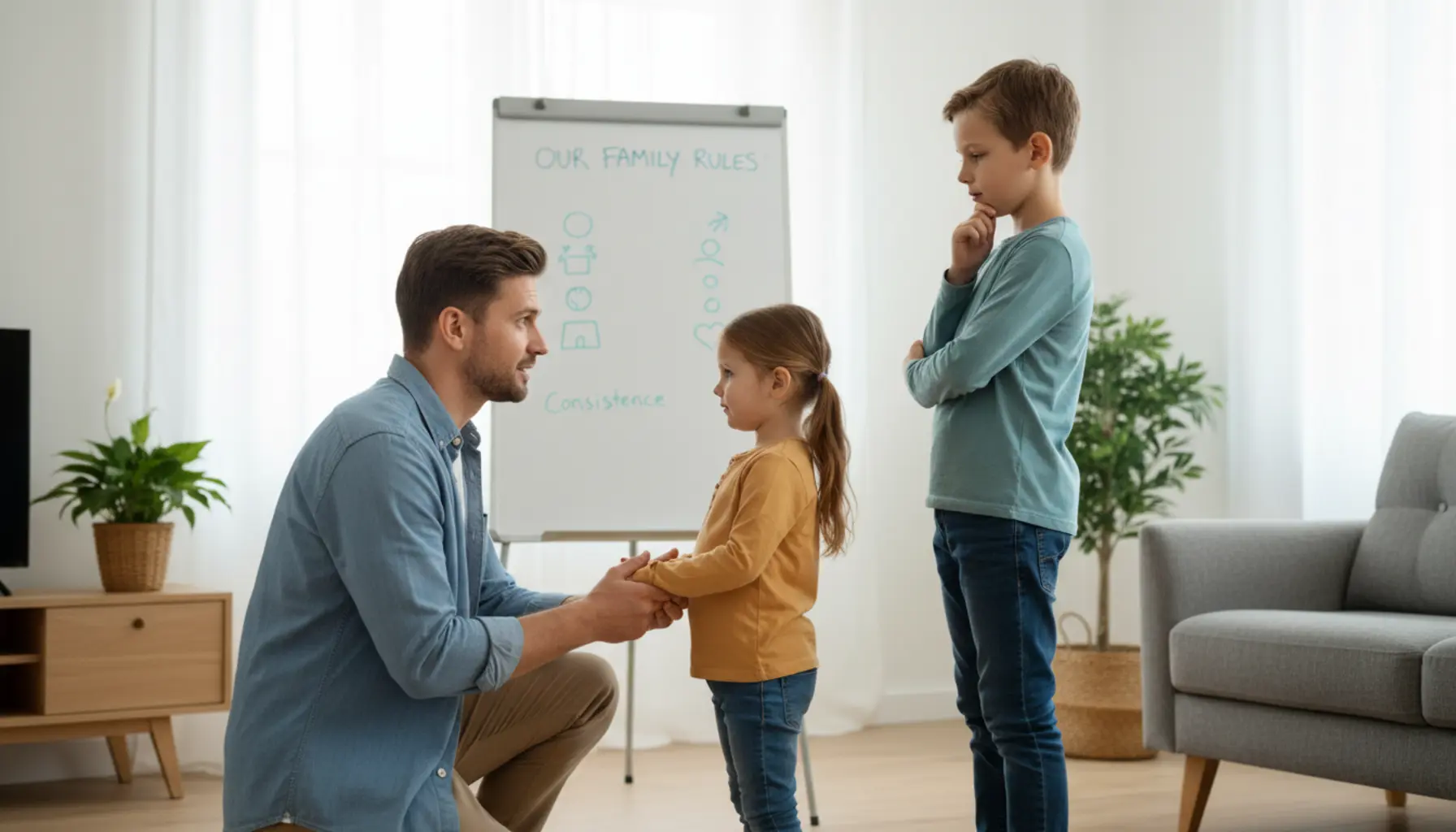
Building trust also requires willingness to listen to “difficult” things – not just successes, but failures, anxieties, doubts, or topics uncomfortable for adults. If a child comes to you with a tough situation – peer conflict, bad grade, admitting to a lie, or first crush – and sees judgment, lecturing, and criticism in your eyes, next time they might say nothing. But a response like: “Thank you for telling me, it’s important to me. Let’s think together about what we can do” builds a conviction that dad is an ally, not a judge. Trust also grows when a father keeps his promises – if you can’t do something, say so directly: “I can’t go to the field today, but let’s plan for Saturday,” instead of vague promises “One day we’ll go” and never returning to it. Children remember unfulfilled promises and read them as a signal that adults’ words cannot be trusted. Still, building a bond does not mean meeting every whim; it’s more about being honest, clear and respectful in communication. Also remember, a father who can take care of his own feelings – able to say: “I’m very upset right now, I need a moment to calm down” instead of exploding – teaches the child that it’s possible to be with emotions without aggression. Such an attitude builds trust, because the child sees that dad is not an unpredictable “volcano,” but someone you can safely talk to. An important part of the relationship is supporting autonomy: encouraging the child to make age-appropriate decisions (choosing clothes, free-time activities, developing interests) and being close by when something doesn’t work out. When instead of “Told you so!” the child hears: “I see it didn’t work out, would you like to try another way or let me help next time?” – they experience acceptance not only in success, but in failure too. This greatly strengthens their trust in you and in themselves. Nonviolent parenting – both physical and verbal – is the foundation: giving up hitting, yelling, emotional blackmail, shaming (“You’re hopeless,” “Look how other kids behave”) and punishments that humiliate, and instead using conversation, logical consequences, and repairing damage, teaches the child that love does not hurt or humiliate. By creating a space where it’s allowed to ask questions, get things wrong, make mistakes, and talk about difficulties without fear of rejection, the father lays the foundation for a deep, lasting bond that becomes the child’s secure reference point throughout adult life.
Parenting methods based on empathy and non-violence
Parenting based on empathy and non-violence assumes that a child is a fully fledged person with their own feelings, boundaries, and needs, not “a project to be fixed.” For the father, this means letting go of the harsh authority model in favor of a partnership relationship, where power comes not from yelling, fear, or punishment, but from calm, consistency, and closeness. The basis of this approach is the awareness that a child’s behavior is a message – they are saying: “See me, something is difficult for me” and the father’s task is to read that message, not suppress it. Empathetic parenting is not permissiveness or “stress-free upbringing”; it’s about clear boundaries set respectfully, without physical and psychological violence. A father who wants to parent this way starts by working on himself: recognizing ingrained patterns from his own family, learning to regulate his own emotions, and to pause before reacting impulsively. Instead of striking words like “You’re overreacting,” “Don’t cry, nothing happened,” he chooses communications that build the bond and teach self-awareness: “I see you’re sad,” “This is important to you, that’s why you’re angry,” “I’m here, we’ll get through this together.” Part of non-violent parenting is also giving up corporal punishment, yelling, humiliation, irony, and threats, which can leave emotional marks for years – even if they “work” in the moment, they teach mostly fear and submission, not responsibility. An empathetic father doesn’t pretend there are no conflicts – on the contrary, he accepts that they are a natural part of relationships and treats them as opportunities to learn: he talks about his feelings, shows how to apologize, and looks for solutions that respect both sides’ needs. A key method is active listening: putting away the phone, making eye contact, paraphrasing (“I understand that…”), checking if he understood the child’s emotions correctly, and refraining from immediate advice. A child who feels truly listened to rarely needs to “scream out” their needs through difficult behavior and cooperates more easily, embracing the rules. In practice, fathers can introduce daily conversation rituals – even just 10 minutes a day of “just dad time,” free from judgment, rush, or criticism. Non-violent parenting also means talking about boundaries differently: instead of “Because I said so,” or “If you don’t stop, you’ll see,” the fact is about I-messages: “I don’t agree to hitting, that’s not ok for me,” “I need some quiet because I’m tired, we’ll talk in a moment,” along with an explanation of why the rule matters. A child who understands the reason behind rules is much more likely to follow them and learns to respect others’ boundaries.
Empathetic parenting methods in practice include several essential tools fathers can use in daily situations: emotional self-regulation instead of outbursts, naming feelings, searching for solutions together, natural and logical consequences, and reinforcing positive behaviors. Emotional regulation means that the father takes responsibility for his own reaction – learns to spot “red light” signals (e.g., muscle tension, raised voice, urge to shout) and takes adult time-outs: stepping away briefly, taking a few deep breaths, communicating “I’m very upset, I need a moment to cool down so we can talk calmly.” This demonstrates to the child that strong emotions aren’t a reason for aggression, and the break is not a punishment, but care for the relationship. Naming feelings is another method – when the child cries, gets angry, or withdraws, the father doesn’t dismiss, but helps name what’s going on: “You look disappointed,” “You’re angry because we have to leave the playground now,” “Maybe you feel ashamed after what your friend said.” With time, the child learns to distinguish anger from sadness or fear – which is the foundation of handling emotions as an adult. In conflicts, instead of imposing the only solution, the father can offer to look for one together: “We both want something different – you want to play, I need you to do homework. How can we solve this in a way that works for both of us?” This teaches cooperation, responsibility, negotiation, and gives the child real influence – without which rebellion or passive resistance are easy. Instead of punishing, nonviolent methods use natural and logical consequences – ones that result directly from the behavior and are not revenge or humiliation. For example: if a child leaves toys out and one breaks, the consequence is going without that toy or getting involved in fixing it, not an extra penalty like “no going outside for a week.” If a teenager comes home late, the father can calmly discuss the stress it caused and set new contact rules instead of starting a row. A very important element of the empathetic approach is also appreciating the effort and process, not just the results: noticing that the child tried, paused before an outburst, apologized, attempted something even if it didn’t succeed. This strengthens intrinsic motivation, not fear of judgment. For many fathers, it’s challenging to overcome the shame of showing affection, but it is precisely warmth, hugs, a gentle touch on the shoulder, or seating the child on their lap in a difficult moment that work as an “emotional bandage” and effectively lower tension. Nonviolent parenting is not a set of one-off tricks, but a style of being with the child that step by step builds the message: “I matter, I can feel what I feel, and even if I make mistakes, dad is on my side and will help me fix them.”
Challenges in the father-child relationship – boundaries and consequences
Setting boundaries and consequences is one of the biggest challenges in the father-child relationship, especially if we want to parent non-violently. Many fathers still carry patterns from their own childhood based on punishment, yelling, or intimidation and clash with the modern approach that promotes dialogue, empathy, and respect. On the one hand, there’s a fear of “spoiling” the child, on the other, the fear of repeating harsh, hurtful methods from their own parents. This tension often results in extremes: either too much strictness or excessive leniency, both of which undermine the child’s sense of security. Healthy boundaries aren’t a wall or a set of prohibitions, but a clear indication: “This is where your space ends, and mine and others’ begins.” Children need boundaries to understand how the world works, what to expect, and what is safe. At the same time, it’s important that these boundaries are in line with the family’s values, not just the father’s moods or outside pressure. In practice, this means the father should first name for himself what truly matters (e.g., mutual respect, physical safety, honesty, cooperation at home), and then consistently translate this into concrete rules. The difficulty is that in daily life boundaries often come to light only when the child crosses them: yelling, hitting siblings, refusing to go to bed, or ignoring requests. In those moments, there’s a temptation for angry outbursts and “autopilot” responses – yelling, threats, scare tactics. From a relational perspective, it’s much more helpful to pause and name what’s happening: “I see you’re very angry, but I can’t allow hitting. We can argue, but can’t hurt each other.” The boundary becomes both clear and respectful, sending the child the message: “Your feelings are okay, but your behavior must have limits.” For many fathers, another major challenge is distinguishing between boundaries and control. Control is an attempt to steer the child so there’s no bothersome behavior and no hard feelings for us. Boundaries say: “This is what we follow in this family,” while still giving the child room for choice where possible. For example: you can choose what to wear, but not go to school without a winter coat; you can say you don’t want a hug, but not insult others when you’re angry. This approach teaches the child responsibility for their choices, and the father – trust in the child’s autonomy.
Consequences are another difficult area, as many parents equate them with punishment. In the empathy-based, non-violent approach, the goal is for consequences to be natural and logical, not punitive. A natural consequence is one that follows directly from the child’s action: if I spill juice, I need to wipe it up; if I don’t pack my backpack, I might forget a notebook and have to deal with it. A logical consequence is set by the adult but still makes sense for the child: if we throw toys, we’re done playing with those toys because you aren’t using them safely. The key challenge for the father is to keep to previously agreed rules without humiliating or shaming, threatening, withdrawing love, or using psychological violence (“I don’t love you anymore,” “You’re naughty,” “You disappointed me”). Consequences work when they’re predictable, calm, and communicated with respect, not in anger. This requires the father’s self-awareness and readiness to take responsibility for his own reactions: “I’m upset and need a minute to calm down. We’ll talk about it soon.” Then, the father serves as a model for regulating tension and showing that strong feelings don’t have to lead to hurtful actions. Also remember, applying consequences without prior emotional connection often leads to rebellion, closing off, or anxiety. A child who feels misunderstood interprets consequences as unfair punishment, even if logically everything is sound from the adult’s perspective. That’s why it’s so important to start with empathy – naming the child’s feelings and needs – and only then move to discuss consequences: “I see you really wanted to keep playing and it’s hard to stop. I get it. Still, we agreed that after this hour the tablet goes away. If you don’t put it away now, tomorrow your play time will be shorter.” That sequence – empathy, clear boundary, consequence – helps balance closeness and structure. From an SEO and parenting practice perspective, it’s important to emphasize that “consistency” applies not just to the child, but to the father: if you promise something – keep your word; if you say you’ll play after work, do your very best to really be present then. Parental inconsistency and unpredictable reactions are among the hardest things for a child – they disrupt feelings of security and make trust difficult. The challenge, then, is for the father to be not only the one who “sets the rules,” but also the one who lives by them: respects others’ boundaries, apologizes when he fails, and shows that consequences also apply to adults. In this way, boundaries stop being a tool of power and become a mutual map that helps the whole family navigate daily life with more peace and mutual respect.
Supporting the child’s development and independence
Supporting a child’s development and independence is one of the most important areas of modern fatherhood, especially if we want to raise children without violence and in a spirit of empathy. A father who sees their child as a developing person, not a “project to be completed,” will be less likely to exert pressure and more likely to accompany them. It’s crucial to understand that independence doesn’t suddenly emerge in the teenage years – it blooms from hundreds of little experiences where the child can try, make mistakes, and return to a parent for support, not judgment. Even a small child can decide on simple matters, such as choosing clothes from two options, deciding how to spend part of the afternoon, or the order of chores. For a father, this means consciously giving the child space, instead of doing things for him “for everyone’s peace of mind.” When you allow your toddler to dress themselves, slowly pour water into a cup, or try to zip their own jacket, you send the message: “I believe in you, you can do it.” It’s also important for the dad to accept imperfect results of these attempts – crookedly buttoned shirts or spilled water – and not react with irony, anger, or by taking over. The child then learns that mistakes are part of learning, not a reason for shame. Supporting development also means creating a rich but not overwhelming environment – time for free play, outdoor activity, interacting with peers, and calm moments with the father, reading, talking, or simply being together without screens. Such daily life, though seemingly ordinary, builds curiosity, a sense of safety, and readiness to discover talents.
An important aspect of supporting independence is the way the father responds to challenges and difficulties the child faces. Instead of immediately providing solutions or taking control, it’s helpful to ask questions that focus the child’s attention on their own resources: “What have you already tried?”, “What do you think could work?”, “Where do you want to start?”. This fits into non-violent parenting by trusting the child and refraining from authoritarian answers. Over time, the child starts searching for solutions themselves, and the father becomes a partner and mentor, not a controller. Empathetic accompaniment also means that when the child experiences failure – loses a match, gets a lower grade, falls out with a friend – the father doesn’t belittle their emotions (“It’s nothing,” “Don’t exaggerate”), but helps name and understand them. Instead of moralizing or comparing to others, focus on process and effort: “I see how hard you worked on that,” “It must have been tough to hear that,” “What would you like to try differently next time?”. A child who receives such support learns they can try without fear of judgment and that they’re important regardless of the result. Independence in practice is also about gradually involving the child in home life – not as an “obligated helper,” but as a co-host. The father can plan simple tasks together with the child: setting the table, sorting laundry, cleaning up toys, planning family shopping, or preparing a meal. The key is a spirit of cooperation, not criticism (“You always spill something,” “Let me do it better”). By giving the child concrete, doable tasks, the father builds their sense of agency and belonging. As the child grows, their range of responsibilities can expand – from packing their own backpack, planning study time, to taking small-scale financial decisions (pocket money, saving). Throughout, one thing remains constant: the presence of a dad who listens, explains, grants the right to try, and respects the child’s development pace. Such a relationship forms a safe base from which the child can bravely head out into the world, knowing they won’t be shamed or punished for their imperfections but will meet understanding and support.
10 practical rules of good fatherhood
A good dad is not perfect – he is good enough, present, and ready to learn. The first rule is conscious presence: instead of “I work for you, that’s why I’m not here,” choose shorter but quality contact – shared breakfast, walks to preschool, reading in the evening, chatting before bedtime. At these times, put away your phone, look your child in the eye, respond to what they say or show, ask questions instead of delivering monologues. The second rule is emotional availability – accepting all of the child’s feelings, even the difficult ones, without judgment (“don’t cry,” “stop being angry”) and without instant “fixing” of the situation. Instead, name what you see (“You look upset because…”), show that emotions are okay and limits concern behaviors, not feelings. The third rule relates to consistency and predictability – a child has to know what to expect from you. If you promise something, keep your word; if you establish rules, uphold them gently but firmly. For example: if you agree to switch off cartoons after two episodes, don’t extend because “they asked nicely,” but help them cope with the disappointment. The fourth rule is respecting boundaries – physical, emotional, developmental. Ask for permission to hug when the child is tense; respect their reluctance for some social activities; don’t force “kisses for auntie” if they resist; instead of “don’t exaggerate,” try to understand what they really need. The fifth rule is setting clear, calm boundaries without violence – say what is and isn’t allowed, in the first person, without humiliating: “I don’t agree to hitting,” “Toys can be shared but you don’t have to give away everything.” Instead of punishments, use natural and logical consequences: if the child throws a toy, take it away for a while, explaining it must be used safely.
The sixth rule of good fatherhood is conscious modeling – a child learns mainly by observing, so pay heed to how you speak about others, how you react to stress, frustration, and mistakes. If you want your child to apologize and take responsibility, apologize yourself when you shout or are unfair and briefly explain what you’ll do differently next time. The seventh rule is supporting independence – instead of doing things for the child, give tasks suitable to their age: let them pour water, clean up after themselves, choose clothes from a couple of options, pack their bag with your help. Remember that learning takes time and mess; don’t quietly correct everything for the child, because the message is “you do it wrong, I’ll do it better.” The eighth rule is regular, honest communication – talk not only when “something happened,” but about everyday details, your own emotions and doubts (of course, adjusted to age, without burdening the child with adult issues). Ask open questions: “What was the nicest thing today?”, “What was hard?”, instead of “Was it good at school?” The ninth rule is playing together – allow yourself to be silly, enter the child’s world, be ready for fun, games, building forts, and living-room dancing. In play, teach fair play, how to lose, and cope with frustration, but don’t treat it as yet another “lesson” – above all, it’s a space for closeness. The tenth rule is taking care of yourself as a father: rest, sleep, support from your partner, chatting with other dads or a professional is not selfish but an investment in your capacity for patience and empathy. If you find yourself frequently erupting, falling back into childhood patterns, shouting, or being verbally violent, treat it as a sign for working on yourself, not proof of being a “bad dad” – seeking help and developing parenting skills is a key sign of responsible and mature fatherhood. By following these practical rules, you can gradually build a relationship based on trust, where your strength lies not in control but in mindful presence, respect, and openness to change.
Summary
A strong father-child bond is built on daily presence, showing feelings, understanding, and consequence without violence. Empathetic communication, support, and clear boundaries develop a child’s sense of security, trust, and independence. Implementing practical rules of fatherhood and modern parenting methods creates a relationship based on mutual respect and love. Remember, authentic connection and conscious commitment from the father are crucial for a child’s happy and harmonious growth.


