
Survival is the art of surviving in difficult, unforeseen conditions, both in nature and in urban environments. Discover the key skills and equipment worth having when starting your survival adventure – begin conscious preparations today!
Learn the basics of survival! Find out what survival is all about, which skills are essential, and how to safely start your adventure.
Table of Contents
- What is survival? Definition and origins
- Basic survival skills for beginners
- Classic vs Urban Survival – Differences and Similarities
- Essential survival gear – What is worth having?
- The most important safety rules in survival
- Benefits of learning survival and personal development
What is survival? Definition and origins
Survival, in the simplest terms, is the art of survival – a set of knowledge, skills, and psychological attitudes that allow you to function in difficult, often extreme conditions, when access to civilized conveniences and external help is limited or completely cut off. It is not only about the “romantic” camping in the forest or extreme expeditions known from television, but about consciously preparing for crisis situations: from getting lost in the mountains, to a car breakdown in a remote place, to the aftermath of natural disasters, power outages, water shortages or the lack of emergency services. On a practical level, survival entails several pillars: securing shelter, water, food, fire, safety, and the possibility of signaling and navigation. Psychology is equally critical here – composure, the ability to make rational decisions under pressure, resilience to stress, and risk assessment skills. Modern definitions of survival emphasize that it is not a “fight against nature” but rather a cooperation with it: observing the environment, making use of natural resources, and minimizing traces of your presence. For this reason, survival is closely associated with the “Leave No Trace” ethic, which assumes respect for the environment and responsible use of nature. In colloquial language, the term “survival” is often misused as a label for anything vaguely military or adventurous, but in reality, it refers to very specific competencies – from basic (making fire in different conditions, building a makeshift shelter, filtering water, basic first aid) to more advanced (navigating without GPS, managing energy and supplies, planning evacuation, improvising tools and equipment). It’s also worth distinguishing survival from bushcraft and prepping: bushcraft focuses on comfortable, often multi-day living in the forest using traditional techniques and tools, while prepping centers on stockpiling supplies and preparing your home or property for long-term crises. Survival, however, is the ability to cope “here and now,” often with minimal gear, with a strong emphasis on adaptation and improvisation. In practice, all these fields overlap, and many enthusiasts combine them into a single, coherent lifestyle focused on self-reliance and responsibility.
The origins of survival as an organized discipline go back much further than modern manuals and TV shows – its roots are in the daily lives of ancient hunters, trappers, shepherds, and sailors, for whom being able to make fire in the rain, find water in the wilderness, or build a shelter with whatever was at hand meant life or death. Over the centuries, survival techniques developed primarily in the military: armies had to prepare soldiers for action away from logistical support, in harsh climates and terrain, with limited resources. In the 20th century, especially during the two world wars, the first systematic survival handbooks for pilots, commandos, or ship crews were created – describing procedures for action after a plane crash, maritime disaster, or being cut off from one’s unit. During the Cold War, specialized SERE (Survival, Evasion, Resistance, Escape) training was developed, teaching soldiers not only how to cope in the wilderness but also how to avoid capture and how to act in captivity. Simultaneously, the civilian outdoor and adventure tourism movement was born – with the development of mountaineering, kayaking, ocean sailing, and long-distance exploration, there was a growing public interest in how humans cope outside “safe” civilization. A pivotal moment for the popularization of survival came in the 1970s and 1980s: best-selling books like John “Lofty” Wiseman’s SAS Survival Handbook appeared, scouting and guiding movements expanded, and with them, mass youth training in the basics of camping, mapwork, firemaking, and terrain navigation. Fears about fuel crises, geopolitical tensions and ecological disasters also gave rise to the first groups of “survivalists,” who aimed to prepare for a possible breakdown of the current order. In Poland, interest in survival rose particularly after the political transformation – when the market opened to Western publications and equipment, and society began to seek new forms of active recreation and ways of building self-sufficiency. TV shows with survival instructors and, later, social media had a huge impact on popularizing the topic, enabling enthusiasts to exchange experiences, knowledge, and gear tests. Today’s survival thus has a double face: on the one hand, it is the continuation of old, practical knowledge about coping in nature; on the other – a response to the challenges of the modern world, where the awareness of the risk of climate disasters, critical infrastructure failures, armed conflicts, or economic crises is rising. As a result, we increasingly speak not only of “classic” wilderness survival but also of “urban survival,” i.e., a set of skills needed to survive in a city during sudden disruptions to normal functioning – from power outages to public transport blockades. All these threads share a common core: conscious preparation, developing practical skills, and shaping an attitude that allows you to remain calm and effective when the things we take for granted fail.
Basic survival skills for beginners
Although survival is often shown in movies as a constant fight against wild nature, in practice, the basic skills focus on a few simple but crucial areas: shelter, water, fire, terrain orientation, first aid, and organizing your equipment. For beginners, the most important thing is to understand that it’s not about extreme challenges, but about building competence step by step. The first priority is knowing how to provide shelter – even a simple tarp stretched between two trees can protect you from hypothermia, wind, and rain, which in real situations are a greater threat than “attacks by wild animals.” It’s worth learning a few basic tarp set-ups (like “A-frame” or “lean-to”) and knots that will hold the structure in the wind. In this context, knowing knots such as the clove hitch, half hitch, figure-eight, or guyline knot makes it much easier to build a simple camp and secure your gear. The next absolutely fundamental skill is ensuring access to safe water. For a beginner, the priority is not distilling water or complicated filters from natural materials, but understanding that water from natural sources almost always needs to be treated. Practice three basic methods: boiling (the simplest and most reliable), filtering through a camping filter or bottle with a built-in filter, and chemical disinfection tablets. At the same time, it’s good to learn to recognize natural water sources – streams, springs, terrain depressions where water collects – and assess potential contamination, e.g., the proximity of buildings, fields or pastures, which increases the risk of bacteria and chemicals. Fire is another pillar of survival but also a skill that’s easily romanticized. At first, master reliable fire-starting with the simplest tools – a lighter, storm matches, and a firesteel. The key is not only to “make a spark,” but also to prepare the materials: dry tinder (birch bark, dry grass, cotton wool, wax-soaked cotton), small kindling, and larger firewood. Practice different fire structures: “tipi,” “log cabin,” or “lean-to,” and learn how to extinguish embers safely and choose a fire spot according to “Leave No Trace” principles and local laws.
Extremely important, and often overlooked by beginners, are skills in terrain orientation and basic navigation. It’s not about wilderness expeditions right away, but being comfortable with map and compass use, being able to determine directions, read terrain features, and travel consciously along trails. Good practice is to exercise “micronavigation” – finding specific terrain features (e.g., trail junctions, streams, clearings) over short distances. Route planning is another skill: assessing travel time, difficulty level, water availability, potential camping sites, and evacuation points. In terms of safety, basic first aid is essential – not advanced medical procedures, but practical knowledge for dealing with the most common outdoor injuries: cuts, burns, sprains, overheating, and hypothermia. The ability to apply a dressing, immobilize a sprained ankle, or recognize dehydration symptoms can determine whether your trip ends with a safe return. Hence, a basic first-aid kit (band-aids, bandages, elastic wrap, gloves, disinfectant, space blanket) should be a bare minimum in your gear. Another very down-to-earth but strategic skill is choosing and packing your equipment wisely. Beginner survival does not require expensive, tactical gear but a thoughtful packing list: comfortable shoes, clothing layers adjusted to the weather, a warm hat, rain jacket, a simple fixed-blade knife or sturdy pocketknife, headlamp, water and energy food supply, as well as the mentioned first-aid kit and fire-starting tools. The key is selection – taking only what truly increases your safety and comfort, packing your kit so the most important things (first aid kit, water, fire source, jacket) are easily accessible when needed. All of these skills share another, often underrated aspect: training your mindset and habits. Practicing composure, decision-making based on facts, not panic, developing the habit of informing loved ones about your planned route, checking the weather forecast, or preparing a “plan B” are the foundations that turn a beginner enthusiast into a conscious survival practitioner, ready not only for a weekend in the woods but also for unforeseen crises in everyday life.
Classic vs Urban Survival – Differences and Similarities
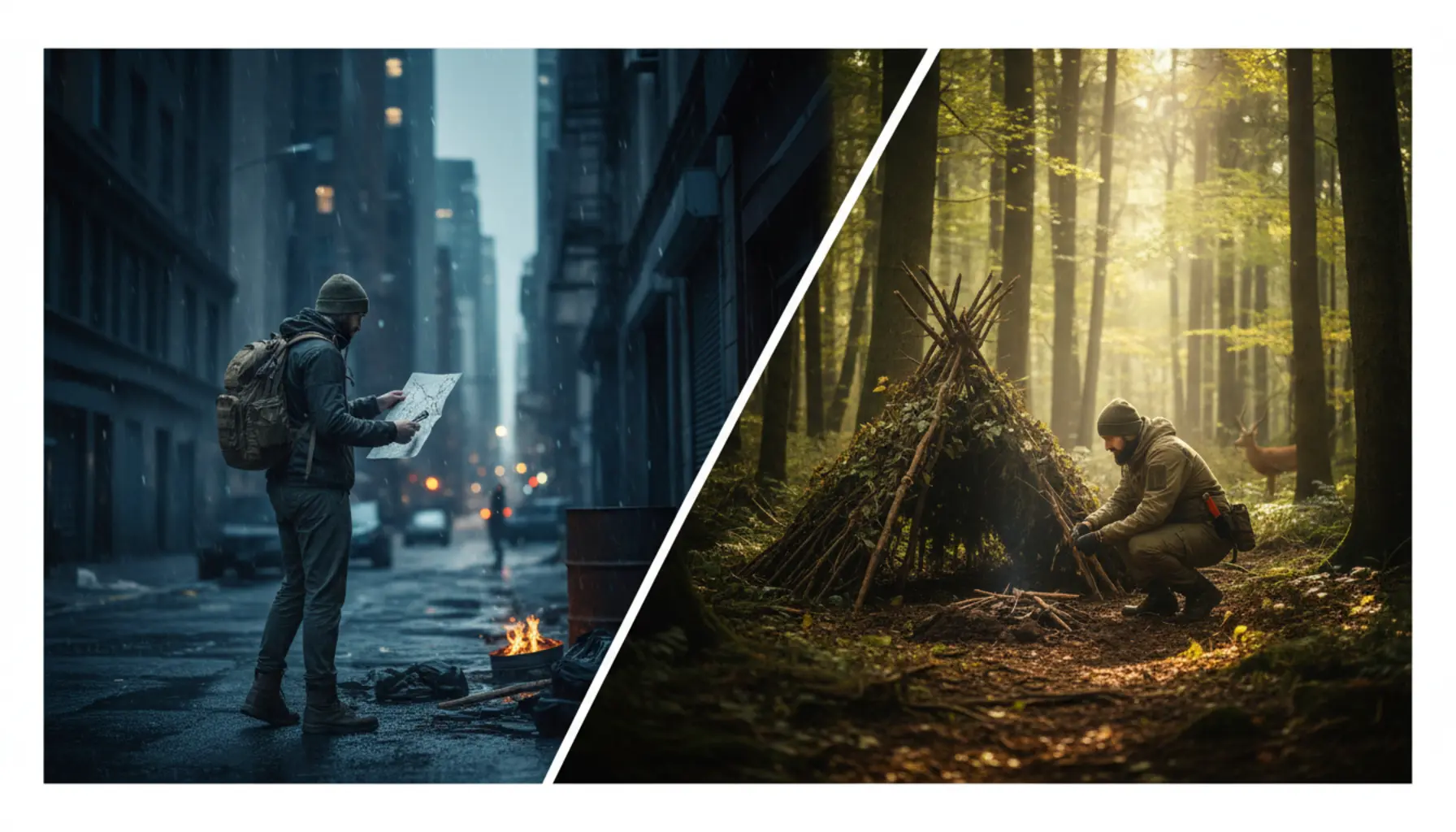
Classic survival is most often associated with wilderness: forests, mountains, remote areas where a person is left mainly to themselves and what they carry in their backpack. The main goal is to ensure five survival pillars: shelter, water, fire, food, and safety, with minimal support from civilization. Urban survival, on the other hand, takes place in a completely different environment – densely built, full of infrastructure, but also dependent on complex systems (electricity, water, transport, communication). There, not only classic survival skills are key, but also knowledge of how the city works, human behavior in crisis, and the ability to use available resources without breaking the law or ethical principles. The difference in environment affects your mindset: in the forest, the priority is often protection against hypothermia, dehydration, and injury, while in the city, one of the main threats may be social panic, lack of access to infrastructure or dangers resulting from crowds. Nevertheless, the basics remain the same – in both cases, preparation, risk assessment, and conscious management of energy and resources are crucial. In classic survival, you train, among other things, shelter building from natural materials, fire-starting in various weather conditions, navigation by map, compass, and terrain, as well as basic food acquisition techniques (foraging, simple traps, fishing). In urban survival, “the terrain” is stairwells, underground garages, rooftops, parks, tram lines, rivers within the city – everything that can be both an asset and a threat. Skills like reading evacuation plans, knowing alternative emergency exits, identifying potential assembly points, or quickly assessing which stores or service points will become “bottlenecks” in case of panic are as important here as using a compass in the woods. Importantly, in the city, water and food are often more accessible (at least at the onset of a crisis), but they greatly depend on logistics and supply chains. In the forest, resources are fewer but more “independent” of the system – you just need to be able to find and use them. This alters the approach to preparation: those focusing on urban survival tend to invest in home stocks, powerbanks, battery radios, flashlights, first aid kits, hard-copy documentation, and a family communication plan, whereas classic survival practitioners focus on lightweight, versatile outdoor gear (knife, firesteel, poncho, tarp, water filter, cord) and terrain knowledge.
There are also marked differences in threats and security priorities. In the natural environment, the main dangers are sudden weather changes, hypothermia, mechanical injuries (sprains, fractures, falls), wild animals and difficult terrain that may delay help. In the city, typical human threats dominate: crime, riots, panic, overcrowding in certain areas, and technical failures (fires, building collapses, electricity and communication outages). Thus, in urban survival, discretion and non-conspicuous equipment (EDC – Every Day Carry), camouflage of actual capabilities and resources, and the ability to negotiate and cooperate with others are vital. In the forest, the rule often is “the more visible you are, the safer” – bright clothing makes it easier for rescuers to find you. In the city, it’s the opposite: conspicuous gear or behavior may attract unwanted attention. Despite these differences, both survival trends share a common competence base: first aid, stress management, planning and task prioritization, improvisational skill, as well as the aforementioned “Leave No Trace” ethic, which in urban conditions can be more broadly understood as responsible use of infrastructure and resources without worsening others’ situation. Whether in the city or in the open, working on your mindset is crucial – maintaining calm, logical thinking under pressure, distinguishing important from urgent things, and the ability to take on the role of leader or conscious team member. From a personal development perspective, it’s good to treat classic and urban survival not as competing, but as complementary fields. Forest training teaches resilience to discomfort, resourcefulness, and respect for nature, while “urban” crisis-response practice (e.g., simulating a power outage at home, limited water or communication) prepares you for the most likely scenarios, which can affect any city dweller. As a result, someone developing both skill sets becomes more flexible: able to function in a totally “shut-down” city, as well as in a remote forest, and their most important tool remains not gear, but their head – knowledge, experience and the ability to make rational decisions based on reality rather than movie-style imaginings of survival.
Essential survival gear – What is worth having?
Essential survival gear does not mean a heavy, overloaded backpack – much more important than quantity is selecting things that genuinely increase comfort and safety. In practice, it’s worth thinking of your kit in terms of the survival priorities: shelter, water, fire, signaling, safety, and basic equipment repair. The foundation is a suitable backpack – durable, with a comfortable carrying system, and of a capacity matched to the type of trip (for beginners, 30–40 liters is often enough). Inside, first and foremost, should be items to protect against weather: a lightweight bivy or tarp, space blanket, rain poncho, as well as a hat and gloves suited to the season. A tarp or plastic sheet plus a few guy lines and pegs allows quick organization of makeshift shelter, even with little experience. The emergency blanket is one of the lightest and cheapest items that can be decisive in retaining body heat in case of hypothermia, so it’s always good to have it, even in the city. Layered clothing is key: moisture-wicking thermal underwear, an insulating layer (fleece, light synthetic jacket), and an outer windproof, waterproof layer. Even the best gear will not compensate for poorly chosen clothing, so beginners should avoid cotton, which retains moisture and cools you down. For water, the bare minimum is a solid bottle or canteen (ideally 1–1.5 l) and a backup, collapsible water container, handy for transporting water from distant sources. Add treatment methods: purification tablets, a simple camping filter or “straw” filter, and for a more advanced set-up – a bottle with a built-in filter. Even for a short trip, a mishap, injury or navigation error can extend your stay, so being able to obtain and treat water is more important than extra food. Remember that a metal cup or mess kit allows you not only to cook food, but also boil water and melt snow, which vastly increases your field flexibility. Although food is a lower priority than water and shelter, your basic kit should include a few high-energy, durable items: energy bars, nuts, dried fruit, freeze-dried meals, or classic “iron rations”. Not only do these offer calories, but they provide psychological comfort, which matters a lot in crisis. In your “emergency compartment” keep a backup supply you don’t use for snacks – regularly check and rotate them before their expiration date.
An essential part of your kit is a fire-starting set – the more methods, the better redundancy and safety. A solid “storm” lighter, classic matches (preferably waterproof) in a sealed container, plus a magnesium fire steel is a set that will let you start a fire in various conditions. Add flammable material: steel wool, cosmetic cotton pads soaked in petroleum jelly, or synthetic tinder, which ignites even when moist. Fire is not just for warming and preparing food – it’s also for signaling and major psychological support, so keep your fire-starting kit accessible and protected in your backpack. Equally essential is a navigation set: a classic topographic map of your area and a simple, reliable baseplate compass. Even if you use GPS on a phone or watch, electronics can fail, so traditional navigation tools are essential for responsible survival. For personal safety, a well-thought-out first-aid kit takes priority – small, but smart: band-aids, bandages, sterile gauze, elastic bandage, disposable gloves, disinfectant, blister pads, a few basic medicines (e.g., painkillers, antidiarrheals), and your regular prescription medications. Your kit should be waterproof and easily accessible, with contents adjusted to your skill level so it doesn’t contain gear you won’t be able to use safely. The main “tool” is a knife – ideally a fixed blade, simple, without unnecessary features, with a comfortable grip and solid sheath. In many situations, a good multitool with pliers, screwdrivers, and a metal saw will also come in handy, especially in urban survival. Among other small, functional items: a headlamp (with spare batteries), rescue whistle, a few meters of paracord or strong rope, repair tape (e.g., duct tape), a needle-and-thread set, spare socks, and a small notebook and pencil for jotting information or keeping a simple field diary. Completing your kit is EDC (everyday carry) gear: a small folding knife or multitool, mini flashlight, keychain with firesteel or lighter, micro personal first aid kit, and copies of important documents, both in digital and hardcopy form. In urban survival, a powerbank, charging cable, and some emergency cash in small denominations are particularly useful in case electronic payments fail. When outfitting yourself, remember: “the best gear is what you know and can use” – regularly practice with your tools so they are not dead weight in your pack during a crisis.
The most important safety rules in survival
Survival safety starts long before you enter the field. The basic rule is planning: inform loved ones about your route, expected return time, and alternative options if the weather or conditions change. Write a simple “emergency plan” – where you intend to spend the night, your possible escape route in case of injury or bad weather, and at which points you have phone reception or access to a road. Be realistically honest about your physical abilities and experience – it’s better to shorten your route or bail on a mountain ridge challenge than to risk a serious accident. Layered clothing matched to the weather and terrain is key; overheating and hypothermia are as dangerous as running out of food. In mountains or forests, always plan so you reach camp before dusk – moving improvisationally in the dark multiplies the risk of falls, losing the trail, or wildlife encounters. The golden rule is to avoid unnecessary risk: don’t enter difficult terrain just to “test yourself,” don’t cross swollen rivers without experience and safety prep, and don’t test homemade constructions over an abyss. The principle “think first, then act” is literal in survival – a moment’s thought saves more lives than the flashiest improvisations.
Another pillar of safety is systematic situation assessment, known in military terms as STOP: “Stop – Think – Observe – Plan.” In practice, after any serious incident (losing the trail, injury, sudden bad weather), don’t keep moving blindly – stop, collect your thoughts, analyze your resources (water, equipment, time till dark, your own and group energy) and pick the lowest-risk solution, even if it means less comfort. Survival safety also includes managing energy wisely – avoid exertion in full sun, take regular micro-breaks, hydrate in small sips, and eat simple, high-calorie snacks to avoid a lapse in concentration, which leads to many injuries. Organize your camp safely: pick a flat, dry spot away from dry stream beds, slopes, dead trees, or rockfall hazard areas; if the terrain has obvious signs of past damage (fallen trees, landslide traces), move. Fire is your ally, but safety demands strict discipline: only light it where allowed, secure the firepit, have water or dirt ready for quick extinguishing, never leave embers unattended, and always put your fire out until it’s cold, crumbled earth. Where wild animals are present, practice area separation: sleep, cook, and store food in different places (with food best suspended) to avoid bringing animals to your shelter. Add hygiene and injury prevention: check your feet often, cover blisters before they turn into wounds, never drink untreated water, and act at first signs of exhaustion or hypothermia. The last crucial safety rule: know when to say “stop” – end your trip, turn back, or call for help when the situation is over your head. Survival is not about proving your bravery, but ensuring you come out alive and wiser – not having your “bravery” end in a rescue operation.
Benefits of learning survival and personal development
Learning survival turns out to be much more than just a set of techniques for coping in the woods. It is a process that genuinely changes the way you think about yourself, others, and the world. One of the most important outcomes is increased mental resilience. Training in controlled situations of discomfort – cold, fatigue, limited comfort, the need to make decisions under time pressure – gradually builds your “muscle” for dealing with stress. Over time, you notice that everyday irritations like a late train or internet outage are no longer real problems, because you’ve experienced situations where safety, not convenience, was at stake. You also develop the ability to act despite fear: walking through a dark forest, setting up camp at night, or making independent decisions in the field teaches you that courage is not the absence of fear, but the ability to act constructively despite it. Survival also teaches humility and realism – beginners quickly notice that movie-style images of “rambo-ing” in the field have nothing to do with responsible behavior. Instead of bravado, you learn to plan, be cautious and analyze risk coolly, which later leads to more thoughtful decisions at work, in business, or at home. Systematic practice in the field also improves organization and self-discipline: you must pack properly, anticipate the conditions, prepare extra water and food, monitor travel time and your physical condition. This is practical self-management training, which pays off in every area of life. You also become aware of your real resources – you learn how little you really need to function, and how much is just optional or habitual comfort. This often leads to a simpler, more conscious lifestyle and greater gratitude for daily “necessities” like hot water, electricity, or a full fridge.
From the standpoint of personal growth, cognitive and social benefits are crucial too. Survival requires constant learning and combining knowledge from many fields – from topography and meteorology, to first aid and psychology, to aspects of law or sociology (especially in urban survival). Your brain is challenged: you plan, analyze, look for solutions, test hypotheses in practice, draw conclusions. During simple exercises, such as starting a fire in various ways, building a shelter with a limited set of items, or planning a route on a paper map, you develop cause-and-effect thinking and improvisation skills. You learn to optimize actions: get more effect for less effort, turn one tool into a multi-tool, or minimize risk by doing things in the right order (shelter and water first, then comfort). This is a very practical school of resource management, directly improving your ability to handle projects at work, personal finances, or non-nature-related crises such as power outages in the city or sudden building evacuations. Developing social skills is key as well. Many survival activities happen in groups – during courses, camps, or outdoor clubs. In such environments, you naturally have to divide tasks, communicate under pressure, resolve conflicts constructively, and support weaker members. Overcoming difficulties together builds trust and belonging, while revealing both strengths and areas for improvement – some lead well, others plan thoroughly, someone else motivates the group. So, survival is a safe testing ground for developing leadership, assertiveness, responsibility, and empathy. At the same time, you strengthen your relationship with nature: being in the field, observing animals, reading tracks, understanding the weather all increase your sense of rootedness and agency – instead of fearing the “wild forest,” you begin to see it as an understandable environment worthy of respect. This, in turn, supports your internal sense of security: you know that even if something gets out of hand in the outside world, you have skills to take care of your own and your loved ones’ basic needs. Such confidence, based on real competence, not gadgets, is one of the most valuable results of learning survival.
Summary
Survival is not just the art of enduring difficult conditions, but also a way for personal development, better understanding of nature, and learning practical skills for life. Sound knowledge of the rules, gear, and safety will make time spent in nature or the city safe and exciting. Whether you choose classic wilderness or urban survival, you will gain confidence and learn to cope with the unexpected. Invest in yourself, choose your own survival path, and discover just how much you can achieve!


