In 2026, many people will face a dilemma: should they rent an apartment or decide to take out a mortgage? In this article, we analyze current trends, forecasted rental and mortgage costs, the impact of interest rates, as well as tips for choosing the best financial strategy. Real estate market experts comment on which solution may be more advantageous in the coming period.
Table of Contents
- Rental cost in 2026
- Mortgage cost in 2026
- Comparison of rates: Rent vs Mortgage
- Impact of interest rates on profitability
- Expert real estate market analysis
- Financial strategies: Rent vs Purchase
Rental cost in 2026
The rental cost in 2026 will largely reflect the tensions we are already seeing today: a housing shortage in the market, rising construction costs, and changes in interest rates and legal regulations. Experts predict that the pace of rent increases will slow down compared to the record years of 2022–2023, but nationwide, we should still expect higher rates than currently, especially in the largest metropolitan areas and academic centers. Three key factors will matter: the level of inflation and wages (which affect the maximum acceptable rent), the availability of mortgages (the harder it is to get credit, the greater the pressure on the rental market), and the supply of new apartments, including those from the primary market and PRS segment (institutional rental). If in 2025 we see further normalization of inflation and stabilization of interest rates, cost pressure on landlords may decrease, but they will still strive to “index” rents to avoid losing the real value of income. In practice, this means that in contracts for 2026, indexation clauses linked to inflation (e.g., the CPI index) may appear more frequently, and tenant negotiations will focus less on the base rate and more on the conditions for future increases, length of the lease period, and scope of additional fees (utilities, administrative fees, parking space). From the perspective of a household considering the “rent or mortgage” dilemma, the rental cost in 2026 needs to be calculated not only as a simple monthly payment but as the total monthly housing expenditure: landlord payment, administrative fee, utilities, internet, potential parking subscription, and in some cases, also tenant liability insurance. Additionally, compared to a mortgage, one must consider the deposit (usually equal to 1–2 months’ rent, increasingly 2–3 in high-demand cities), agency fees (if using an agency, typically equal to 1 month’s rent), and the cost of equipping the apartment if it is rented in “basic” standard or unfurnished. Over the multi-year horizon 2024–2026, a frequently overlooked but real cost of renting is also “forced mobility”: moving out due to the owner selling the apartment, rent increases not accepted by the tenant, or changes in contract terms, generating costs of relocations, refreshing renovations, and time spent searching for new accommodation.
If we look at forecasts for 2026 rental rates, analyst scenarios for major cities indicate possible further increases of several to a dozen percent year-on-year, but with significant divergence between locations. In metropolises like Warsaw, Kraków, Wrocław, Gdańsk, or Poznań, the effects of a strong job market, inflow of workers from other regions and abroad, and limited supply of new flats in central districts will still apply, potentially keeping rates high and vacancy rates low. In smaller provincial cities and satellite towns around large agglomerations, the pace of rent increases may be lower, but the “spillage” of demand phenomenon is becoming more apparent – people unable to pay for central rentals seek cheaper alternatives in remote districts or neighboring municipalities, raising prices there as well. It’s important to note that in 2026, rental costs will also depend on the standard of the building and apartment: new premium projects with reception, monitoring, coworking zones, and fitness zones will be priced much higher, and part of this “premium” is actually the cost of extra services and operating fees, which a mortgage holder usually pays in other ways (e.g., higher housing community fees for renovation funds and security). At the same time, it should not be assumed that all rental apartments will hold up high rents – where more supply appears (e.g., completion of large investments, entry of further PRS funds into the market, an increase in flats transitioned from short-term to long-term rental), owners may be more willing to negotiate, offer rent holidays, or include some fees in the rent. For rental profitability against mortgages, the rent-to-local net wage ratio will be important – if the monthly cost of renting a two-room apartment in a large city exceeds, for example, 40–50% of an average single’s take-home pay, there will be greater pressure to seek mortgage alternatives (often as a couple) or relocate to a cheaper area. Thus, in 2026, we can expect further market segmentation: some tenants, especially professionally mobile individuals, will still accept high costs for flexibility and no long-term commitments, while others – observing the total cost of renting in a multi-year perspective – will start to see it as a relatively expensive “admission ticket” to a big city, and not an optimal living model.
Mortgage cost in 2026
The cost of a mortgage in 2026 will be the result of several key elements: the level of NBP interest rates, bank margins, type of interest (fixed vs variable), own deposit, and additional fees and insurances imposed by financial institutions. After a period of very high interest rates in 2022–2023, the market is gradually entering a stabilization phase, but this does not mean a return to the “cheap money” known from the pre-pandemic era. The consensus of many economists is that in 2026, interest rates in Poland may remain at a moderate level – higher than in 2015–2019 but lower than at the peak of the tightening cycle. For borrowers, the most important effect will be the monthly installment cost, which largely depends on reference indicators (WIBOR/WIRON) and negotiated margins. After experiencing sudden rate hikes, banks may continue policies of strict creditworthiness assessments, indirectly impacting costs – customers with worse risk profiles (lower incomes, unstable contracts, smaller own deposit) will pay higher margins and may be “forced” to buy extra product packages (current account, credit card, life or job loss insurance), increasing the actual cost of financing the property purchase. In 2026, the difference between fixed-rate and variable-rate mortgages will be especially significant. After the jumps in installments in many families, there is a growing tendency to “buy security” by choosing fixed rate loans for 5–10 years. These products stabilize the household budget by making the installment predictable, but typically come at a slightly higher upfront cost – the bank prices in the risk of future rate changes. In 2026, the difference between fixed and variable rates may not be as significant as during the rapid tightening era, but a fixed-rate mortgage will remain a “premium” product. For many families, the key will be to calculate whether the additional cost of this security over several years is acceptable compared to the potential risk of rate increases with a variable rate.
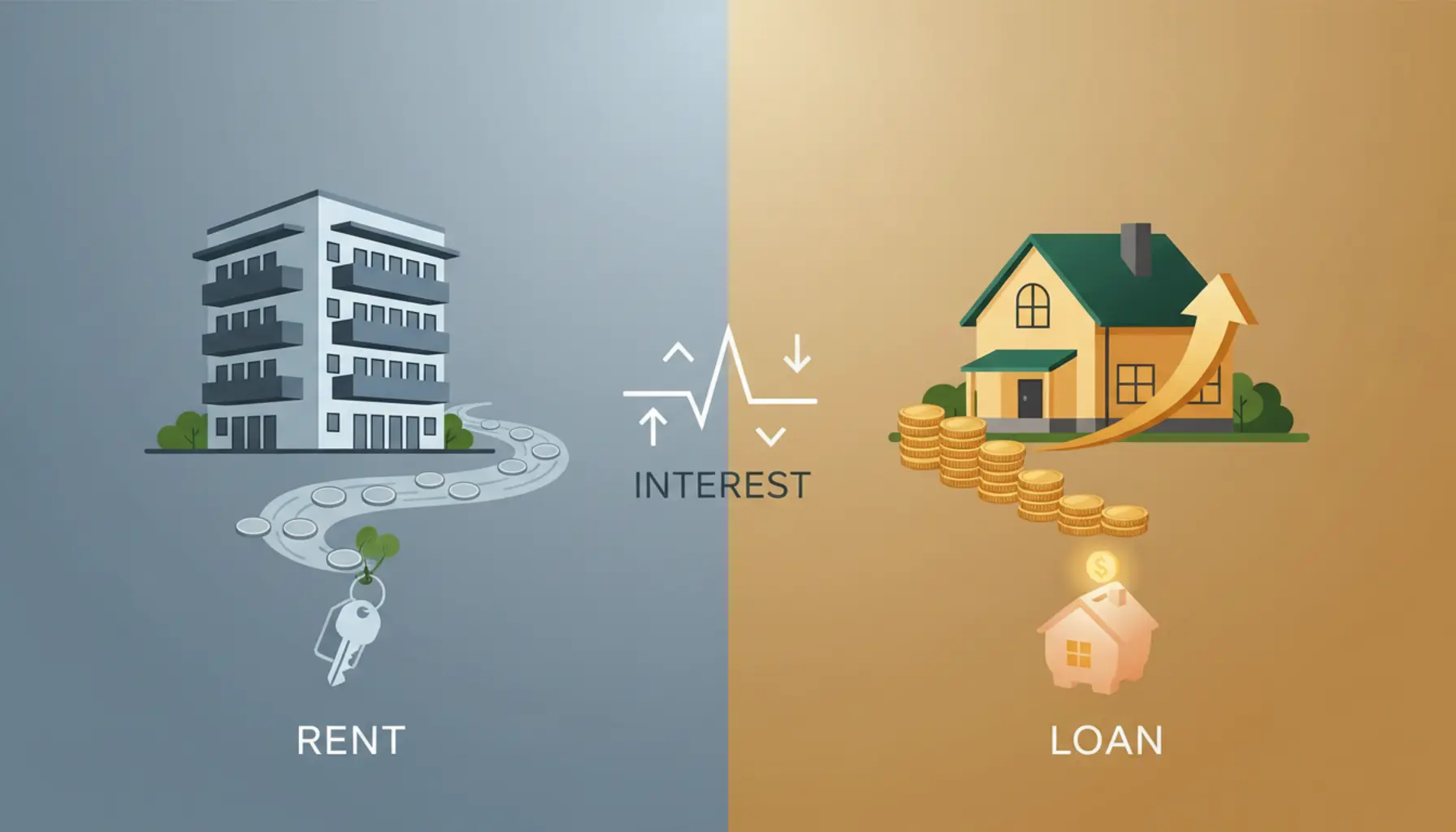
The final mortgage cost in 2026 will also be strongly influenced by the required own deposit and the price of real estate. A higher deposit (20–30%) will still mean not only a lower loan amount but usually also better conditions – lower margin, no need for low deposit insurance, and sometimes more room to negotiate commissions. From a profitability perspective compared to renting, it’s important to compare the monthly installment to the local market rent for a given city and market segment (studio, two-room apartment, premium segment). In many locations, even in 2024–2025 we are seeing a situation where the mortgage installment with a 20% deposit is similar to or only slightly higher than the cost of renting a similar apartment, and part of the installment repays capital, thus building one’s own assets. However, it’s important to remember that the monthly installment is not the only cost – with a purchase come transactional expenses (PCC tax, notary fee, broker’s commission), bank fees (loan handling fee, property valuation, entry of the mortgage in the land registry), and in subsequent years, maintenance, renovations, and housing community renovation fund fees. In 2026, the mortgage cost could also be affected by the existence of government support programs, e.g. installment subsidies for specific groups (young people, families with children), which reduce the effective interest rate and increase creditworthiness, but often spur demand and in consequence, real estate prices. Therefore, when analyzing mortgage profitability, it is essential to run simulations for several scenarios: with and without subsidies, with various own deposit levels, fixed and variable installment, and considering possible changes in interest rates over 5–10 years. Only such a holistic approach allows a real comparison of mortgage cost vs rent cost in 2026, instead of comparing only the installment to rent ratio.
Comparison of rates: Rent vs Mortgage
Comparing rental rates and mortgage costs in 2026 requires a look not only at the “dry” monthly payment but also at the structure of this expense and what you actually get in return. For renting, you pay for immediate access to an apartment – with no equity building, but also with no long-term liability. The mortgage installment consists of the capital portion (paying down the property value) and the interest portion (cost of borrowed funds). When analyzing profitability, it’s worth comparing: rent + utility fees vs mortgage installment + fixed costs (e.g., renovation fund, property insurance, real estate tax). In large cities in 2026, expected rents are about 2800–3500 PLN for a 40–50 m² apartment in a good location, whereas a mortgage installment for a similar apartment with a 20% deposit and moderate interest rates may fall within a similar range, although much depends on the purchase price per square meter, bank margin, and variable or fixed rate choice. The key difference is that in rent, the entire payment goes to “usage,” while in a mortgage installment, especially after a few years, the capital share increases, which is a form of “forced savings” and equity building. So the monthly amount alone does not tell the full story – with a similar budget burden, a mortgage may be more profitable over the long term by growing your assets, at the expense of less flexibility and higher upfront capital requirements.
In profitability analysis for 2026, different scenarios and sensitivity to economic environment changes must also be considered. In the base scenario, assuming moderate NBP interest rates and still high but stabilizing demand for apartments in the largest cities, the rent-to-mortgage installment ratio will be similar in many locations – especially for two-room apartments bought by people with a 10–20% deposit. For tenants, the key question will be how much of their salary is taken up by rent, and whether incomes can outpace rent indexation – which, with continued inflation of services, will be the natural mechanism for landlords to preserve purchasing power. For mortgages, the important factor is the household’s resistance to rate hikes (for variable rate loans) or the need to accept a slightly higher installment for the peace of mind that fixed rates offer for the first 5–10 years of repayment. One should also remember the impact of government programs: if forms of credit subsidies exist in 2026, this can temporarily improve the installment/rent ratio, but simultaneously drive up apartment prices, offsetting some benefits, particularly in major cities. In smaller towns, the picture may be different: there, rents remain relatively lower, while purchase prices and credit costs can mean the mortgage installment significantly exceeds the rental alternative – especially factoring in extra ownership expenses, investments in finishing or equipage, or the risk of occasional vacancies if letting the apartment later. With renting, negotiation and mobility matters more – the ability to change apartments or cities to adapt to the labor market or lifestyle changes is a value not shown in charts, but it may be as important as a 200–300 PLN difference between rent and mortgage installment. Financially, the higher the deposit, the longer planned stay in a given location, and the more stable the employment, the greater the chance that in 2026, a mortgage will be more profitable than renting, even if on paper the monthly installment is a dozen percent higher than the rent. People with unstable incomes, planning frequent moves, or lacking savings for a high deposit and transaction costs, despite supposedly similar “rate” levels, will still be safer financially and in life choosing rent as a form of temporary access to accommodation rather than taking on a long-term mortgage commitment.
Impact of interest rates on profitability
Interest rates are one of the key factors differentiating the profitability of renting and mortgages, as they directly affect the cost of money over time. In practice, this means that with higher interest rates, mortgage installments grow, reducing the financial advantage of owning in relation to renting – at least in the short to medium term. In 2026, after a wave of rapid rate hikes in 2022–2023 and potential subsequent stabilization, the market will likely find itself in a phase of “moderately expensive money”: no longer the cost peak of credit, but still far from the ultra-cheap period of 2015–2019. For prospective borrowers, the crucial link is between the NBP reference rate and interbank market indexes (e.g., WIBOR/WIRON), which form the basis of mortgage loan rates. Even seemingly small changes, such as 1 percentage point, with a typical 25–30-year loan, can raise the installment by several hundred PLN, directly affecting whether the monthly debt-servicing cost is above or below the rent for a similar place. In a higher rate environment, banks often tighten creditworthiness criteria, further limiting credit access and, paradoxically, maintaining strong demand for renting and upward rent pressure. Thus, interest rates indirectly impact not just mortgage installment sizes but also rental prices through supply-demand market equilibrium and individual investor appetite for buy-to-let purchases.
Analyzing profitability in 2026, two levels of interest rate impact need to be distinguished. First, we have the immediate effect – on the current monthly household budget burden. If in a given city the mortgage installment with a 20% deposit and current NBP rates is equal to or significantly higher than the local market rent, and there remains a risk of further rate increases, many people will choose renting as a safer, more flexible option. Second is the long-term effect – on the total cost of property financing and the speed of capital accumulation. In the early years of a mortgage, most of the installment is interest, highly sensitive to rate levels, and a relatively small part goes to capital. The higher the rates, the longer the “paying for interest” phase, and the less favorable the mortgage becomes compared to renting, where the entire amount can be treated as an expense for housing services with no long-term liability. In 2026, fixed and variable rate loans will play a special role. Fixed-rate loans (for 5–10 years) allow “freezing” the cost of money during periods of high uncertainty, making repayment predictable, but usually start with higher interest than variable-rate loans. People who believe rates will fall may treat renting as a bridge solution for 2–3 years, postponing purchase until the installments really become cheaper. For borrowers with very stable incomes, planning to stay in one place for 10–15 years or more, it may be worth accepting higher short-term rates, hoping to switch to better terms in the future or to make extra repayments when rates drop, reducing the total interest cost. The impact of Monetary Policy Council expectations and the macroeconomic situation cannot be ignored. If the job market remains strong and inflation under control, moderate or slightly declining rates may support mortgages as a way to hedge against long-term rent increases, which usually follow wages and inflation. The reverse – continuing high inflation and pressure for further rate hikes – favors renting, as it decreases the predictability of mortgage costs and increases the risk of straining the household budget. In 2026, the profitability of renting vs mortgage will largely depend on individual risk tolerance for interest rate changes: those preferring stability may choose fixed-rate mortgages or longer rental, while those willing to accept cost fluctuations for the potential equity gains will be more likely to take a mortgage even at relatively high rates.
Expert real estate market analysis
When analyzing the profitability of rent and mortgages in 2026, real estate market experts point to several interrelated phenomena: a persistent housing shortage, slow “thawing” of household creditworthiness, changing demand structure, and the growing role of institutional investors. The first and key factor is supply – Poland still lacks hundreds of thousands of homes and the housing gap, while slowly shrinking, remains evident in the largest cities. Rising construction, material, and labor costs in 2022–2024 have caused some developers to scale back or defer new projects, potentially resulting in fewer ready-to-move-in apartments coming to the market in 2026 than current demand would indicate. Experts also highlight the “filtering” of resources – older secondary market flats increasingly offer cheaper rental options, while new premium developments target wealthier clients, deepening market segmentation. At the same time, the largest agglomerations – Warsaw, Kraków, Wrocław, Tricity, or Poznań – are seeing steady population inflows: both internal migrants from smaller towns and foreigners, mainly from Ukraine, Belarus, and Asia. This means that demand for apartments – especially for rent – remains high, even if the general economic situation is less than ideal. Analysts point out that Poland’s rental market is professionalizing: the share of institutional rental (PRS – Private Rented Sector), funds, and companies renting entire buildings rather than single units is growing. These entities are introducing quality standards, long-term contracts, and rent indexation to inflation, which stabilizes but also systematically raises rent levels. For the average tenant, this means fewer “below-market” deals and more predictable, but higher, rental costs. On the other hand, institutional investor participation limits the supply of properties for sale, which experts say may keep purchase prices relatively high even in periods of falling credit demand. In 2026, other macroeconomic factors will come into play: anticipated inflation stabilization slightly above the NBP target, possible normalization of real wages, and interest rates remaining moderately higher than in 2015–2019. After the turbulent 2022–2023 period, many households have regained some creditworthiness, but banks continue to follow cautious risk policies – especially for those on civil contracts, self-employed, or working in volatile sectors. In practice, this means part of the demand that would have opted for a mortgage a few years ago remains “trapped” in the rental market, strengthening rent pressure especially in small and medium-sized, well-connected apartments.
Experts also predict significant regional and segment differentiation in 2026. In the largest cities, apartment prices for sale may remain stable or slightly increasing, driven by limited new projects, investor demand, and the still relatively sound job market. In smaller towns and depopulating regions, price pressure will be much weaker, and local corrections (especially for larger, less attractively located apartments) are possible. This diversity directly affects the profitability equation of rent vs mortgage: in Warsaw and Kraków, a mortgage installment for a 40–50 m² apartment purchased in 2026 with a 20% deposit may be similar or just slightly higher than the market rent for the same class of unit, whereas in smaller locations, installments often significantly exceed local rent rates. Demographic and socio-cultural trends are also important. Younger generations (25–35 years) value mobility, job flexibility, and the ability to relocate, favoring longer tenancies. People over 35, especially with children, more often treat a home as a “life base” and accept higher monthly costs in exchange for building equity and a sense of security. Experts indicate that rising energy and environmental requirements – such as insulation and heating standards – will gradually favor modern, well-insulated buildings. In practice, living in a new building, though more expensive to buy, may generate lower long-term utility costs than an old tenement or prefab block, shifting the mortgage profitability equation. Analysts also stress the impact of housing policy: programs supporting first-home purchases, deposit guarantees, or installment subsidies can periodically “heat up” the market, drive up prices, and limit selection, but also improve financing access for some households. From the viewpoint of individual investors considering buy-to-let purchases, 2026 may be a period of greater selectivity – “buying anything, anywhere” will no longer work, and in-depth analyzing of the local market: demographic forecasts, infrastructure plans, proximity to transit or universities will gain importance. Experts warn that a possible economic slowdown or rising unemployment in coming years will most affect low-quality rental and over-leveraged homeowners, potentially increasing the number of properties for sale and triggering local price corrections. Conversely, in a relatively stable macroeconomic scenario, the 2026 housing market will more likely reward “quality” than “easy profit”: both tenants and buyers will compare total living costs – from purchase price or rent, through utilities, to taxes and regulatory risk – and the rent vs mortgage decision will increasingly result from a complex, multi-pronged analysis rather than a simple comparison of monthly installment with rent.
Financial strategies: Rent vs Purchase
The financial strategy related to housing in 2026 isn’t just a matter of comparing the monthly rent and mortgage installment. It’s a choice between different ways of managing assets, risk, and financial liquidity. Rental can be considered a “housing subscription” – you pay for using the property but retain great flexibility, low entry threshold, and lower risk of long-term indebtedness. A purchase with a mortgage means building equity at the cost of higher commitments and reduced mobility. A rational strategy thus requires calculating not only current expenses, but also the alternative gains from capital that would have to be tied up as a deposit, in transaction costs, or renovations. People choosing to rent can use the money saved (e.g., 100,000–200,000 PLN that would otherwise go to a deposit and furnishing) to build an investment portfolio – in bonds, funds, IKE/IKZE, or ETFs. With a conservative annual rate of return of 4–6%, such a portfolio could, in the long run, compensate for the lack of capital payments in a mortgage installment. The “rent and invest the difference” strategy assumes that if the rent is clearly lower than the mortgage installment (or similar, but without additional owner costs such as renovation fund, insurance, or property tax), the difference and non-frozen capital work on the financial market. The key is actually and systematically investing – if the surplus simply goes into consumption, the advantage of this strategy disappears. For tenants, it is also important to build a safety buffer: instead of spending the maximum possible on a mortgage, keep 6–12 months of living expenses in a savings account, boosting resistance to job loss or rent increases. In 2026, with the still unstable macro environment, flexibility and high liquidity may be more important to some households than the “peace of mind” of ownership. Renting can also be combined with other strategies – e.g., temporarily renting in a big city while buying a cheaper property for lease in a small town, for future use or diversification of income sources.
Purchasing an apartment, especially on credit, is more of a “capital-centric” strategy. The monthly installment is split into capital, increasing your net assets, and interest – the financing cost. In 2026, with moderate but still higher than a decade ago rates, the interest share in the early years will remain significant. From a financial strategy perspective, it pays to maximize the own deposit to a level that doesn’t disturb liquidity (not dropping below a buffer of several to a dozen months’ expenses) because a higher deposit reduces credit costs, lowers margin, and reduces the risk of “technical bankruptcy” if prices fall. A popular approach in 2026 will be the hybrid model: part of the savings allocated to deposit, the rest kept in liquid assets as a safeguard against installment increases (in variable rate loans) or unexpected repair expenses. For people with stable, high incomes and a plan for several years’ residence, buying with a fixed-rate mortgage for the first 5–10 years can be part of a broader wealth-building strategy – it combines a predictable burden with potential value growth and some inflation protection. In a scenario where interest rates fall over time, a strategy could be a variable-rate mortgage with planned early principal repayments, shortening the credit period and reducing interest. It’s then worth predetermining a “repayment schedule” – e.g., devote every pay raise or annual bonus to extra repayments instead of lifestyle inflation. In 2026, tax optimization and use of public support will become increasingly relevant: buyers should consider the option of subsidized installments, tax reliefs, or preferential conditions for specific groups, comparing these to possible limitations (price, size, location limits). Whatever you choose – rent or purchase – an effective financial strategy requires counting real costs over a 10–20 year horizon, not just the first year: including rent inflation, income growth, potential repairs, utility costs, and an exit scenario – selling or relocating upon changing plans.
Summary
The choice between renting and a mortgage in 2026 depends on many factors, such as costs, changing interest rates, and your individual financial situation. Despite the currently high mortgage rates, in some cities, a mortgage can be more profitable than renting. Experts predict that interest rates may fall in the future, affecting lending costs. It is important to assess the long-term financial benefits of each option and tailor your strategy to a changing real estate market. Analyze your financial goals and take care of your future financial stability.