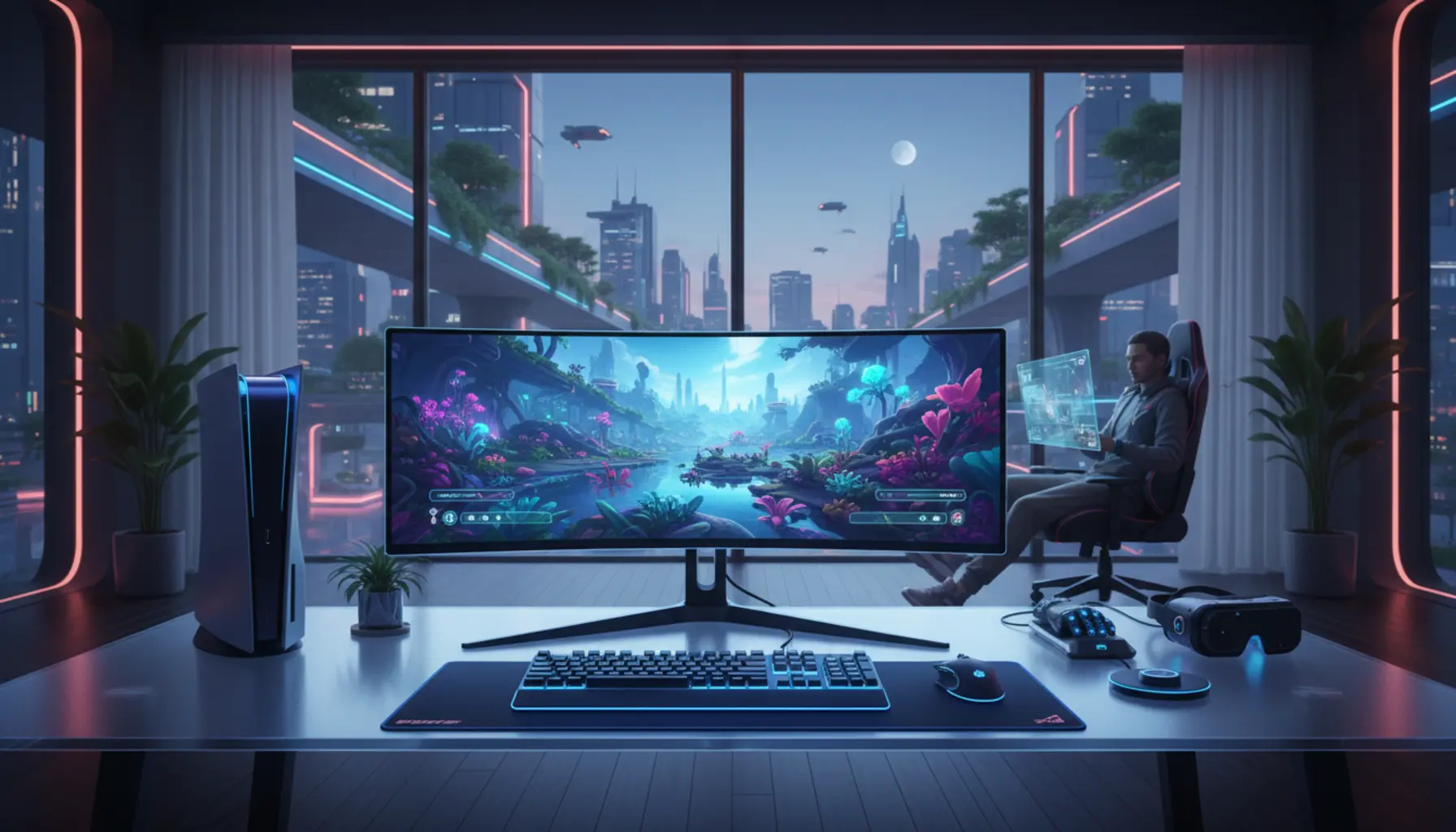
Gaming in 2026 brings revolutionary changes for players and creators. New technologies and the release of major titles are shaping the future of gaming and market dynamics. Gaming in 2026 means more intense experiences, increased interactivity, and broad accessibility for fans of various genres.
Table of Contents
- Gaming Innovations 2026
- Anticipated Game Releases
- Impact of New Technologies on Gaming
- The Role of Sony and PlayStation in 2026
- Comebacks and Sequels: What’s Coming?
- Market Reports and Forecasts
Gaming Innovations 2026
The year 2026 marks a moment when many technologies mature enough to move out of the experimental phase and become an actual standard in the gaming world. Foremost are developments in graphics and performance, but breakthroughs in artificial intelligence, 5G/6G networking, streaming, audiovisual immersion, and the ways players interact with virtual worlds are equally significant. Console manufacturers are preparing refreshed “Pro” class hardware, set to provide stable 4K/60–120 FPS with next-generation ray tracing. On PC, it is becoming increasingly plausible that image reconstruction and frame generation technologies (DLSS, FSR, XeSS, and their next iterations) will become the default way to play, delivering much higher visual quality with moderate computational demands. In 2026, ray tracing will also become standard not only for lighting but also for full global illumination, advanced shadows, and reflections in open-world environments, which, combined with more realistic particle physics and environment destruction, will bring game visuals closer to cinematic quality. At the same time, there is greater emphasis on optimization—studios are learning to design games for multi-core processors, making high-end experiences available even on mid-range hardware. On the design level, generative AI is being used more boldly: procedural side quest generation, NPC dynamic dialogue reacting to player style, and even adaptive difficulty levels that analyze player behavior in real-time and modify enemy AI, loot, or mission progress accordingly. In 2026, it won’t be surprising to see large titles featuring conversational AI, with which players can talk via voice to naturally explore the world’s lore—without having to click through dozens of dialogue options. Creators are also experimenting with story personalization on an unprecedented scale: instead of a few main endings, there will more often be fluid, tailor-made narratives, where AI discreetly connects pre-prepared narrative modules, adjusting the pace and tone of the story to the player’s choices and available playtime. Added to this is intense development in audio technologies—spatial 3D sound using head tracking is to become standard, and adaptive music will dynamically analyze not only the in-game situation but the player’s style, increasing tempo when the system detects the player losing focus or getting bored.
The hybrid gaming direction is also gaining momentum: in 2026, many major releases will work concurrently on consoles/PC locally and in the cloud, allowing players to seamlessly switch between modes without losing progress. Next-generation streaming services will leverage 5G and emerging 6G networks, as well as edge computing, to minimize latency, making AAA gaming on smartphones or lightweight laptops a real alternative rather than just a novelty. Parallelly, the handheld segment is developing: more powerful, energy-efficient AMD APUs and ARM designs integrated with cloud ecosystems will enable publishers to offer “one account, many screens”: start a session on your TV, continue on a handheld while commuting, and finish on PC—no need to install extra versions. 2026 will see a lot of talk about “micro-immersion”: subtle, but meaningful improvements to game presence—ranging from advanced haptic feedback in controllers and gamepads (precise simulation of surface texture, impacts, recoil, or trigger resistance), through improved motion controllers and eye-tracking in VR/AR, to minimalist wearable accessories (bracelets, bands, lightweight vests) that extend tactile sensations without having to wear a full haptic suit. VR and AR in 2026 are boldly moving beyond the “niche” segment: lighter, more comfortable goggles similar in form to glasses and with better ventilation, higher resolution micro-OLED panels, wider field of view, and polished passthrough features make mixed reality (MR)—blending real and virtual elements—the natural environment for many games. This trend is supporting the development of “game platforms” meant to act as social hubs: a single production can combine various modes (PvE, PvP, creative, social), with players transitioning smoothly between them as if moving from room to room in a giant virtual house. Growing integration with social platforms and content creation tools (built-in video editors, simple clip montage systems, generative thumbnail and description tools) means that anyone can become a creator in 2026—games are designed to support virality, short-form video, and shared experiences. On the horizon is the development of the digital economy: although enthusiasm for blockchain and NFTs has waned, developers continue to work on more transparent and regulated systems of digital asset ownership, including cosmetics, skins, or seasonal passes that can be resold legally and safely. This is complemented by rising accessibility standards—in 2026, extensive control options, scalable UIs, screen reader support, real-time captioning, and personalized difficulty profiles will become standard, meaning games will be designed from the ground up for the broadest possible audience.
Anticipated Game Releases
The 2026 release calendar already evokes huge excitement, as there are both entirely new IPs and sequels to the biggest hits of recent years on the horizon. Players can expect the return of cult series in refreshed, heavily next-gen form—think further entries in big-budget action RPGs, vast open-world sandboxes, and dynamic online shooters fully utilizing ray tracing, advanced physics, and the adaptive AI systems described earlier. There’s particular buzz around new installments of brands that already function as “games as a service”: in 2026, they’re set to receive not just classic expansions but near-sequel updates, rebuilt progression systems, new continent-scale maps, and entirely new seasonal gameplay models. Titles on the edges of genres will also gain prominence—such as hybrid RPG-roguelites with survival elements, action games blending tactical and narrative-driven mechanics, and co-op PvE productions leveraging cloud-based simulations of massive battles, impossible on traditional hardware. A proliferation of “micro-immersion” titles is also predicted: shorter, but intense single-player experiences, often episodic, built around a strong mechanical or story concept, designed for shorter weekday gaming sessions.

2026 will also be a breakthrough year for VR and AR releases—several major studios already announced flagship titles built from scratch for new-generation goggles, with full body, gesture, and facial tracking, enabling a whole new level of immersion in social and co-op games. Expect expanded simulators where players manage their own virtual metropolises at 1:1 scale, explore photorealistically recreated cities, or participate in narrative adventures where every head or hand movement matters to the outcome. Simultaneously, the AR market will see a wave of titles blending the real world with virtual layers—from city exploration games to strategic “battles” played on a desk or living room floor, to educational projects gamifying everyday activities. For traditional games, an important 2026 trend will be so-called “cross-platform ecosystems”: titles launched simultaneously on PC, consoles, mobile devices, and in the cloud, with full cross-play and shared progression systems, significantly lowering entry barriers and allowing players to transition seamlessly between devices. Special attention will also be given to games centered on the digital economy—not speculative blockchain projects, but thoughtfully designed user-creation systems where players can create and sell their own skins, maps, scenarios, or even whole campaigns in curated marketplaces integrated with the game itself. Plans also include many inclusivity-focused productions: 2026 launches are set to offer wide character customization options (from appearance to identity to accessibility for people with disabilities), and narratives will be targeted at a more diverse audience, showcasing cultures, perspectives, and themes rarely present in mainstream gaming. In the background, the “mid-budget” trend will flourish: high-quality, mid-budget games from experienced but smaller studios using new AI tools and graphics engines—some of the biggest sleeper hits of 2026 might come from this segment, gaining organic popularity through community recommendations.
Impact of New Technologies on Gaming
In 2026, the impact of new technologies on gaming will be felt at every stage of the player experience—from how games are created and distributed to the gameplay itself and the communities they build. Advanced graphics engines with enhanced ray tracing, global illumination, and next-gen upscaling techniques (DLSS, FSR, XeSS, and successors) will make photorealistic visual quality standard not only for top AAA productions but also for mid-budget titles. Developers will be able to achieve “next-gen” quality without vast optimization budgets, opening space for riskier, more creative projects. Improved APIs (DirectX 13, new Vulkan versions) and hardware ray tracing support in graphics cards and next-gen consoles will allow creators to focus on artistic layers rather than technological constraints. At the same time, a distinction will grow between “what’s possible” and “what’s comfortably playable,” further pushing image reconstruction and adaptive scaling algorithms into the mainstream to keep animation fluid even at 120 fps. Approaches to physics and environment destruction will change—GPUs with dedicated physics accelerators and new simulation libraries will allow nearly fully destructible environments, prompting more emergent gameplay where players create solutions, not just follow set paths.
Equally significant will be the impact of artificial intelligence and cloud technologies on how games are designed, updated, and received by players. By 2026, generative AI will become the invisible co-author of many productions: from tools streamlining asset, animation, and dialogue creation to systems responding in real-time to a user’s play style. NPCs will have more advanced behavior and dialogue models, capable of learning player and community preferences via cloud processing, not just replaying scripted routines. Dynamic storylines, adaptive quests, and personalized challenges—generated from gameplay histories—will make a single title nearly infinitely replayable. Powerful clouds—faster data centers, better connectivity, edge computing—will make the hybrid gaming model (local + cloud) the dominant standard. Players will be able to smoothly shift gameplay between consoles, PCs, handhelds, and smartphones, with resource-hungry computations like world simulation, AI, or streaming ultra-high-res textures often offloaded to remote servers. This opens up new monetization and digital economy models: extensive cosmetic item markets, “cloud premium” subscriptions (for higher graphics quality or priority servers), and cross-game ecosystems where character progression and collections migrate between a publisher’s titles. VR and AR development—supported by lighter goggles, eye tracking, haptics, and 3D audio—will drive “micro-immersion”: even short sessions will be intense and deeply engaging, and AR elements will seep into daily life as live events, interactive concerts, and urban location-based games. Collectively, these technologies will not just push technical and visual quality—they will transform game design philosophy: from static products to living, evolving services, tightly integrated with communities and the digital economy.
The Role of Sony and PlayStation in 2026
In 2026, the PlayStation ecosystem will remain one of the industry’s main pillars, setting standards for high-budget productions and network services alike. Sony will continue to reinforce its position via an “exclusive-first” strategy, with exclusive games as the key player magnet. Further entries in flagship franchises—from elaborate, cinematic action games to big-budget RPGs and online co-op titles—will be tailored to leverage all the capabilities of PlayStation 5 and potential refreshed versions (like PS5 Pro or regular PlayStation VR2 bundles). Maintaining “AAA prestige” quality will be a priority for Sony, but they will simultaneously expand into games-as-a-service updated for years post-launch. In practice, this means more investment in live ops teams, regular seasonal content, advanced progression systems, and developed social components to keep players in the PlayStation ecosystem for thousands of hours. In 2026, integrating the console with mobile and web apps will also be key—personalized social hubs, real-time stats, machine-learning-based recommendations, and user-tailored PS Store offers will strengthen brand loyalty. Sony will additionally expand its transmedia strategy: film and TV adaptations of games (and vice versa) will become important promotional channels and methods for growing franchise universes. Streaming platform viewers will automatically become potential players, and game releases will be accompanied by cross-media events, in-game limited items, TV-inspired skins, and special in-game events.
From a purely technological perspective, 2026 will be a period of consolidation and innovation deepening for Sony, rather than hardware revolution. PlayStation 5, supported by firmware updates, new dev tools, and full ray tracing/advanced image upscaling, will be the destination platform even for the most ambitious productions. Sony will focus on user experience improvements: faster interfaces, broader use of DualSense adaptive triggers and 3D haptics in first-party games, and stronger cloud service integration. Developing hybrid gaming within PlayStation Plus—streaming games to various devices and easily switching between local and cloud play without losing progress—will become increasingly natural in 2026. Facing competition from subscription and cloud service giants, Sony will balance the value of exclusive launches with content availability pressure. More likely ports to PC with shorter delays (yet still prioritizing “PlayStation first”) can be expected. PlayStation VR2 will become a key segment—Sony will contract both large cinematic single-player experiences and mid-budget, highly immersive projects built for VR. The essential ingredient for success will be pairing VR with traditional gaming: cross-play between screen players and headset users, unified progression systems, and short, intense “micro-immersion” sessions enabling players to sink into a game world without spending hours at a stretch. Sony will also emphasize inclusivity and accessibility: extensive control schemes, broad accessibility settings, support for specialized controllers, and refined localization will set first-party brands apart. Thanks to this, in 2026 PlayStation will be seen not only as a “hardcore blockbuster” platform but as an ecosystem open to diverse groups, from casual subscribers to esports athletes and content creators using built-in recording, editing, and streaming tools.
Comebacks and Sequels: What’s Coming?
2026 will be heavily marked by the return of well-known brands and long-awaited continuations—the sequels and reboots are set to grab player attention in a landscape increasingly saturated with new IPs. The main focus will be big-budget action and RPG series already established as “system sellers” in previous console generations. Publishers, aware of the risks of investing in entirely new brands, are betting on recognition—but with a modern twist: sequels are no longer just about safe repetition, but deep reengineering of known formulas for new trends—ray tracing, generative AI, and hybrid distribution models. In practice, 2026 will bring sequels that not only expand the worlds of beloved series but also change how players interact with them. Long-running action RPG franchises will get entries focused on open worlds with dense networks of activities, where side quests are no longer pre-scripted lists but dynamically generated stories responding to the player’s style. Narrative shooters and TPP games may use AI to create enemies that learn from player behavior and support more dynamic, less “arena-like” action scenes. For Sony and other key publishers, sequels will naturally showcase exclusive hardware features—whether adaptive controls, advanced haptic feedback, or new forms of hybrid streaming enabling seamless switches between local and cloud modes. On PC, refreshed entries of known series will debut with graphics profiles tailored to next-gen graphics cards with specialized ray tracing and AI acceleration cores, producing even more detailed world geometry, realistic lighting, and intelligent upscaling. Another important trend will be the comeback of classic PS3/X360 era (and older) brands, which in 2026 will see not only remasters but fully-fledged reboots. Publishers are realizing that the generations who grew up on these games now have both nostalgia and the financial means to re-invest in their favorite series. Reboots will thus be designed as “bridge” titles: faithful to the original’s spirit, but fully adapted to modern standards with robust accessibility, photo modes, social integration, and creator tools like level editors or internal “mod workshops.” In the horror and survival genre, several cult IPs are predicted to return, utilizing ray tracing and 3D sound for a heightened sense of dread and implementing micro-immersion—short, dense horror sequences perfect for quick sessions after work or school. Many of these, although still focused on single-player campaigns, will get optional co-op and timed social components, fitting the wider live-service trend with seasonal updates and evolving story arcs. Simultaneously, a “double A” resurgence will be noticeable: mid-budget sequels using AAA pipelines but targeting more focused, often auteur-driven experiences. These projects, from smaller or premium indie teams, will be especially bold in experimenting with gameplay mechanics and structure: sequels may forego classic open worlds for denser, more curated locations where every element matters to the story and player choices truly change the game world’s dynamics. As a result, 2026 will deliver a wide range of comebacks—from cinematic spectacles to intimate tales—united by an attempt to balance nostalgia with technological and design courage.
An important aspect of 2026’s comebacks and sequels will be how they approach transmedia storytelling and the digital economy around brands. The biggest franchises—especially those owned by Sony and other global publishers—will increasingly operate simultaneously across games, series, films, and digital comics, with new titles serving as the core from which a content ecosystem is built. Sequels will launch alongside new adaptation or spinoff seasons, broadening audiences and attracting those who previously only knew the brand from TV or streaming. Gameplay-wise, this will mean deeper character customization inspired by TV versions of heroes and event-based storylines allowing players to replay scenarios from other media. Returning series will also address growing expectations for representation and inclusivity—in new entries, advanced character creators will give players greater versatility over appearance, identity, and personality. Side characters will come from diverse cultural backgrounds, deepening immersion and aiding global brand positioning and expansion. At the same time, comebacks will be even more closely tied to the digital economy: seasonal passes, battle passes, cosmetics, and limited collectibles will remain significant revenue sources, but their design will be more transparent and player-friendly in response to monetization fatigue. Sequels will leverage advanced data analytics and AI to tailor offers in real-time—static stores will give way to dynamic recommendations based on player preferences and style, boosting satisfaction and reducing the sense of being “forced” to buy. Creative economy features will gain prominence: in-game modding, level creation, skins, or even mini-campaign tools will become an integral part of some sequels, enabling players to share and monetize original work in a controlled manner. For publishers, it extends franchise lifespans without needing immediate new installments, while the community gains real influence over the direction of favorite series. Also noteworthy: many returning brands will implement mechanisms allowing progress, inventory, or key narrative decisions from previous titles to be imported, further strengthening franchise loyalty. In 2026, sequels won’t just be “numbered entries”—they’ll act as nodes in networks connecting platforms, media, and interaction models, where the player’s role far exceeds simply “completing” a campaign.
Market Reports and Forecasts
Analyst reports forecast that by 2026 the global video game market will exceed several hundred billion dollars, with growth rates somewhat slower than during the pandemic boom but still stable and clearly outpacing many other entertainment branches. The fastest-growing segments will be mobile games and subscription models, set to generate significant portions of revenue for both AAA publishers and indie studios. Researchers emphasize that diversification will be key in 2026: besides boxed and digital sales, cosmetic microtransactions, seasonal passes, paid story expansions, and content partnerships with streaming or lifestyle brands will become increasingly important. The games-as-a-service segment will further consolidate; a handful of the most popular live-service titles will grab the lion’s share of revenue, pushing studios to seek narrower niches or experiment with hybrid monetization forms. At the same time, market reports warn about consumer fatigue with aggressive earning mechanisms—by 2026, players are aware of their value and expect clearer digital economy models, directly impacting brand images and retention indicators.
Platform structure forecasts suggest that new generation consoles and their refreshed versions will maintain a strong position, but the revenue growth dynamics will shift toward cloud and mobile devices powered by hybrid gaming models. Analysts expect that by 2026, the number of active streaming and subscription users will grow by tens of percent, with subscriptions to rich game libraries becoming as standard in gamer households as VOD services are for movies and TV. The PC segment, according to reports, will remain the main space for innovative indie titles leveraging early access and crowdfunding. Geographically, Asian and Latin American markets will see the largest player growth, while North America and Europe will focus on monetizing the existing user base via advanced personalization, network infrastructure, and cross-platform integration. Regulatory issues will be increasingly important: by 2026 more countries will have clear guidelines on loot boxes, child protection, personal data, and ecosystem interoperability—forcing publishers to adapt to varying legal requirements. The inclusive and accessible game trend also repeats in 2026 outlooks: advanced control customization, scalable difficulty, and robust accessibility settings will not only be welcomed but become market standards, influencing reviews and purchase decisions. VR and AR, according to analysts, will grow more steadily and maturely—steady user increases based on improved comfort, lower prices, and better content offers, with an emphasis on simulators, social games, and short, highly immersive experiences are expected. All these forecasts share one conclusion: in 2026, commercial game success will not come solely from big budgets and advanced tech, but from skillfully leveraging market data, player analytics, responsible monetization, and building consistent, engaging brand ecosystems.
Summary
The year 2026 looks exciting for the gaming world, with numerous new releases and the return of beloved titles. Technological innovations—such as advances in consoles and gaming platforms—will play a crucial role, undoubtedly changing how players experience their favorite games. Sony, with its PlayStation engagement strategy, is preparing for major success by supplying the market with a new generation of hardware. Market forecasts show the gaming industry’s value will grow rapidly, providing a significant opportunity for everyone interested in this dynamic sector.