Brewing coffee like a barista requires not only good beans, but also precision and knowledge of various techniques. With the right preparation and by choosing the method that suits your personal preferences, it is possible to achieve a café-quality taste at home. Discover practical steps that will help you gain full control over the flavor and aroma of your coffee.
Table of Contents
- Selecting Beans and Their Quality
- Coffee Grinding Techniques
- The Art of Brewing Espresso at Home
- Rules for Steaming Milk
- Ideal Proportions and Temperature
- First Steps in the World of the Home Barista
Selecting Beans and Their Quality
The quality of the coffee in your cup begins much earlier than at the espresso machine—at the moment you choose the right beans. For anyone wanting to brew coffee like a barista, it’s crucial to understand the differences between species, origin, processing, and freshness, as these factors decide most about aroma, body, and the complexity of the brew. The basic division is Arabica and Robusta: Arabica is more delicate, with a more complex aroma profile, often featuring notes of fruit, flowers, chocolate, honey; it commonly has higher acidity and lower caffeine content. Robusta features more bitterness, “earthy” or nutty notes, a thicker body, and more caffeine. Baristas most often choose blends dominated by Arabica (e.g., 80/20) for espresso, in order to combine sweetness, complexity, creamy crema, and a solid caffeine “kick”, while for pour-over methods, 100% single-origin Arabicas are preferred. When selecting coffee, pay attention to origin: beans from Central America (Guatemala, Costa Rica, Honduras) are often balanced, with chocolate, caramel, and stone fruit notes; South American coffees (Brazil, Colombia) are sweeter, with nuts and cocoa; African coffees (Ethiopia, Kenya, Rwanda) are generally more fruity, floral, with distinct acidity; Asian coffees (Indonesia, India, Vietnam) tend to be heavier, earthier, more spicy. Conscious selection of the region allows you to steer the flavor profile for a given method—e.g. an Ethiopian coffee with notes of jasmine and citrus is ideal for a V60, while a Brazilian chocolate-nut blend works well for milk-based espresso. The processing method is also very important: “washed” processing gives a cleaner, brighter profile with pronounced acidity and distinct fruit notes; “natural” or dry processing enhances sweetness and fullness, often yielding notes of red fruit, ripe berries, and even wine; “honey” (semi-washed) is a compromise—offering sweetness with a relatively clean profile. Baristas often match processing to the method: “washed” for pour-overs for clarity, “natural” or “honey” for espresso for richer sweetness and fuller body. Specialty coffee beans, which describe such profiles in detail on the label, make it easier to match coffee to your preferences. Quality is also determined by altitude—higher altitude coffees (listed as masl or SHG/SHB) are typically denser, harder, and more aromatic, giving more complex brews. In your daily choices, read the label as you would a vintage wine: region, altitude, botanical variety (e.g., Bourbon, Typica, Caturra), processing, and even the farm and harvest year—all indicators that the producer cares about quality and transparency in the supply chain.
A key element in choosing beans is freshness and roast style. It’s best to select coffee from artisan roasters specifying the exact roast date rather than just an expiration date. For pour-over methods (V60, Chemex, drip, Aeropress), use coffee roasted within 7–30 days; for espresso, stabilized beans are often preferred—10–45 days after roasting, once CO₂ degassing has progressed far enough for more consistent extraction. Coffee that is too fresh may behave unpredictably during brewing, produce excessive crema, and deliver a cup dominated by gas, while coffee that’s too old will taste flat, papery, and lack sweetness. Roast degree should be thoughtfully chosen for the method: light roast highlights acidity, fruitiness, and terroir, perfect for filters and black coffees; medium roast balances sweetness and acidity, and is very versatile (espresso + filter); dark roast brings more pronounced bitterness, chocolate, caramel, and smokiness, desired by those who like intense, “strong” coffee, but it’s easy to get a burnt, ashy taste and lose the bean’s original characteristics. Professional baristas are increasingly avoiding very dark roasts, as they hinder flavor control and limit aroma spectrum. The appearance of the beans is equally important: high-quality beans are uniform, similar in size, without many defects or cracks or signs of mold; the surface should not be oily (a glossy appearance often means a very dark, possibly over-roasted bean). Avoid pre-ground coffee—baristas almost always use whole beans and grind them just before brewing. Ground coffee loses aroma very quickly, so if you want café-level quality at home, a grinder is as important as a good espresso machine. Also, pay attention to packaging: ideally, coffee comes in an airtight bag with a one-way valve to allow CO₂ out while keeping oxygen out; avoid transparent packages that let light in and hasten aroma loss. Finally, consider ethics and ecology—many specialty coffees have certifications (like Fair Trade, Rainforest Alliance) or at least clear information about direct trade with the farm. Such transparency usually goes hand-in-hand with high bean quality and stable producer conditions. Consciously selecting coffee in terms of species, origin, processing, freshness, roasting, and storage forms a strong foundation for all barista techniques you’ll use later—even the best espresso machine cannot compensate for poor or ill-chosen beans.
Coffee Grinding Techniques
Grinding coffee is one of the most important stages that separates an average cup from a barista-level brew. The degree and uniformity of the grind determine how quickly water flows through coffee, how much flavor is extracted, and whether the cup will deliver pleasant sweetness or unpleasant bitterness. The rule is simple: the longer the water-coffee contact, the coarser the grind should be; the shorter the extraction time (e.g. espresso), the finer the grind. Pour-over machines typically use a medium grind, alternatives like drip or Chemex call for medium-coarse or coarse, and espresso requires a very fine grind—almost like powdered sugar, but still with perceptible granules. Repeatability is also critical—if you grind by eye and at random each time, a consistent flavor is hard to achieve. A barista always aims for precision: they set a specific grind size, control the extraction time, and adjust grinder settings in response to changes in humidity, bean freshness, or roast style as needed.
The foundation of home café-quality brewing is a suitable grinder. Blade grinders, while cheap, chop the beans unevenly, causing both very fine dust and large chunks to form. This leads to uneven extraction—some coffee gets over-extracted (bitter notes), some under-extracted (acidity and flatness). That’s why the barista standard is a burr grinder—conical or flat—that crushes beans into even particles. In home kitchens, a high-quality manual burr grinder or an electric burr grinder with precise adjustment is optimal. Manual grinders offer great control and portability and are often better value for quality, though they require effort and time; electrics give convenience and consistency but require attention to the setup and burr quality. Regardless of type, regular cleaning is essential—old coffee residue oxidizes, adding rancid flavors, while built-up oils can affect grinder operation. A practical technique is grinding “just before brewing” in the measured dose (e.g., on a scale—typically 1g of coffee per 15–18g of water for filter methods and 1:2 for espresso) rather than grinding “in advance”. It’s also good to link grind sizes to specific brewing methods: French press requires a very coarse grind to limit over-extraction during prolonged contact; moka pot works with a fine grind, but not as fine as espresso, or it risks clogging the filter; Aeropress is flexible and typically allows experimenting between medium and fine grinds depending on brew time and recipe. In barista practice, if coffee tastes too acidic, immature, and watery, a finer grind often increases extraction intensity; if the brew is too bitter, heavy, and astringent, a coarser grind is usually the answer. Such conscious adjustments are a key barista technique: rather than changing everything at once, modify just the grind and observe the effects. It’s helpful to note your attempts (grind size, brew time, proportions, flavor result) so you can develop your own “map” of grinder settings for different methods. This way, grind control ceases to be a lottery and becomes a creative tool, allowing you to bring out completely different flavor profiles from the same beans.
The Art of Brewing Espresso at Home
Brewing espresso at home like a professional barista starts with understanding what espresso really is and how many factors have to work together for a thick, aromatic brew with creamy crema on top. Espresso is a concentrated form of coffee prepared under high pressure—about 9 bars in professional machines—usually in 25–30 seconds, using about 18–20g of coffee for a double espresso, yielding 36–40g of brew. At home, proper equipment is essential: a pressure espresso machine with portafilter (manual or semi-automatic), a quality burr grinder, and accessories such as a tamper, barista scale, and milk jug if you plan to make milk drinks. Even a mid-range home espresso machine, with a good grinder and proper calibration, can offer café-level results. The first step is preparing your workspace and equipment. The machine should be well-heated—turn it on at least 15–20 minutes before brewing so the brew group, portafilter, and cups reach a stable temperature. It’s good to run hot water for a few seconds before the first shot (a “flush”) to equalize temperature and clean the shower screen. Always put the portafilter into the heated machine—a cold portafilter chills the water and leads to poor extraction. A well-heated cup also helps keep espresso at the right temperature, preserving full flavor. Next, prepare your coffee dose. Use fresh beans suitable for espresso, best from a roaster that clearly marks the roast profile. Weigh 18–20g on your scale (for a double, though the exact value depends on the basket and espresso machine), then grind them very finely in the burr grinder right before brewing. Grind size is crucial: too coarse yields watery, acidic, “empty” espresso; too fine results in overly bitter, “burnt” and intense shots, often with a slow or blocked flow. In practice, properly ground espresso resembles fine sand or cornmeal in consistency, but the ultimate criteria are flow time and taste, not just appearance. Pour the ground coffee evenly into the portafilter basket, distribute it (e.g., by shaking or using a WDT—Weiss Distribution Technique tool) to avoid voids and clumps, then tamp with an even, calm motion. The tamping force should be consistent (about 15–20kg of pressure), but above all the surface must be perfectly even—otherwise, water will take the path of least resistance, causing channeling and uneven extraction. After tamping, clean the portafilter rim, insert it into the heated group, and start extraction without delay to avoid “scorching” the coffee on hot metal.
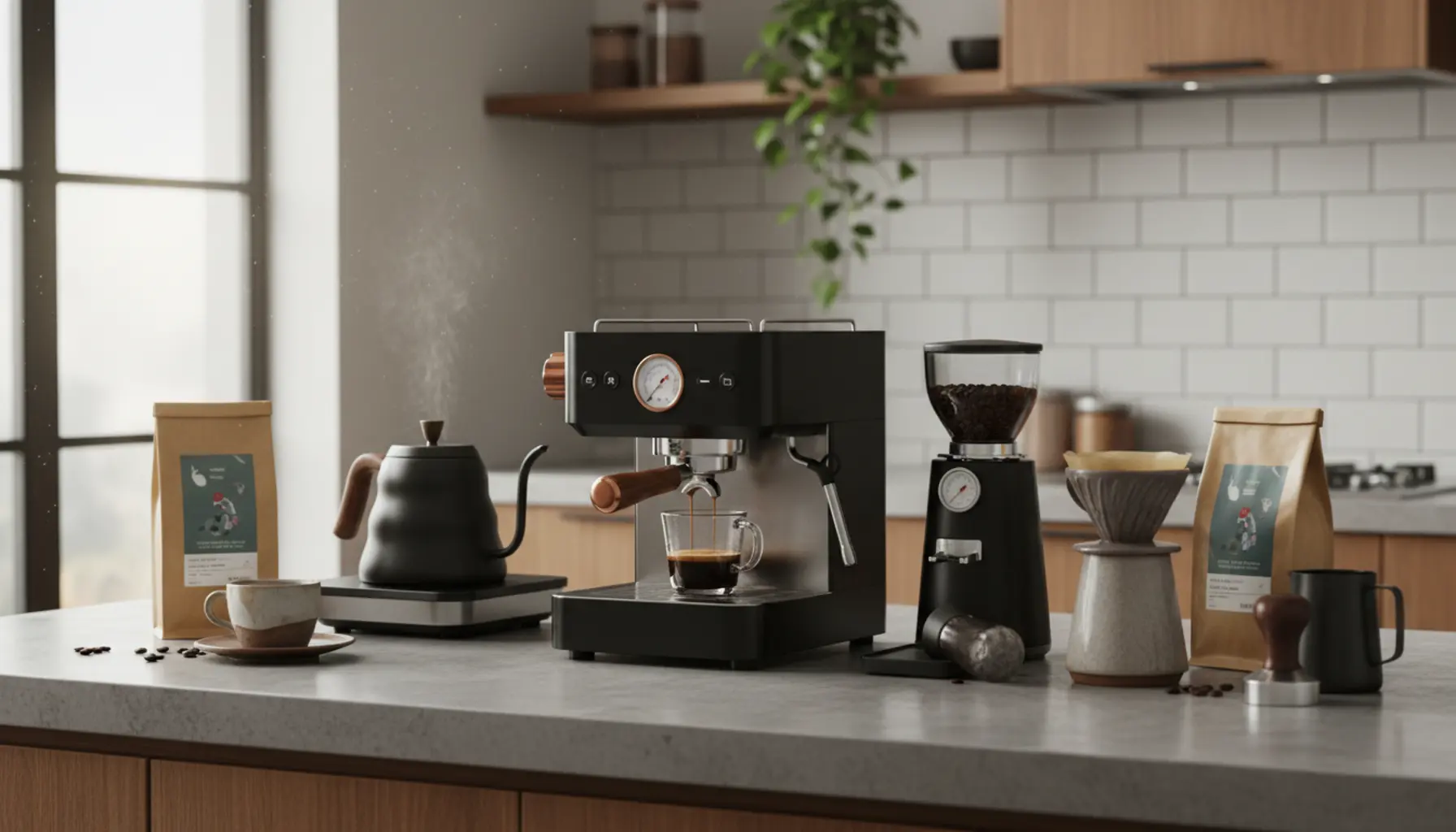
During extraction, you must control three parameters: time, ratio (the so-called brew ratio), and flow stability. It’s a good practice to place a scale under the cup and start it at the same time as the pump—this gives you full control over your output. For a classic double espresso with 18–20g of coffee, the goal is to yield 36–40g in 25–30 seconds from the moment the water starts flowing. If espresso flows too fast (e.g., 36g in 15–18 seconds), it usually means the grind is too coarse, the dose is too small, or tamping was insufficient; the brew will be lighter, more acidic, lacking sweetness and depth. If the flow is too slow (over 35 seconds), espresso may become excessively bitter, astringent, and heavy—usually, you should grind a bit coarser or reduce the dose. Watch the stream: it should ideally look like a smooth, sticky, golden-brown cord, beginning with mouse tails and then settling into an even stream; if you see spurts, irregular flow, or sputtering, that’s a sign of channeling during distribution or tamping. Pre-infusion is also important, if your machine has the feature: a short, gentle pre-wet under low pressure (e.g., 3–6 seconds) pre-soaks the puck evenly and reduces channeling risk, improving espresso balance. After extraction, evaluate the espresso—crema should be thick, golden, with no big holes, lingering for a while—but in the end, flavor is what counts: a good espresso combines balanced acidity, pleasant sweetness, and moderate, refined bitterness. If sharpness and sourness dominate, grind finer or extend extraction a bit; if heavy, ashy bitterness dominates, do the opposite—grind coarser or cut extraction time. Keep a simple coffee journal: note the date, bean variety, dose, extraction time, output in grams, and your flavor impressions—for every coffee, you’ll systematically reach the ideal setup. Never forget the role of water: it should be filtered, medium-mineralized (approx. 80–150 ppm TDS), as hard water skews taste and causes scaling, and soft water gives a flat brew. After each shot, discard the puck, flush the group, clean the shower and basket, and every few days use a backflush agent (if your machine allows it)—clean internal parts directly impact flavor and extraction stability. Regular testing, minor grind and dose tweaks, and using the scale and timer ensure that every shot brings you closer to barista level, turning home espresso brewing into an exciting precision craft.
Rules for Steaming Milk
Steaming milk is one of a barista’s key skills, without which it is impossible to make a proper cappuccino, latte, or flat white. The foundation is choosing the right milk—classic cow’s milk with 3–3.2% fat provides the fullest texture and natural sweetness, as fat contributes creaminess and protein stabilizes the foam. Lower fat milk will foam more easily into a high, light froth but will be less silky in the mouth and will collapse quickly. Plant-based alternatives (oat, soy, almond) usually require “barista” versions—with added proteins and stabilizers—to achieve a similar texture to cow’s milk; regular plant drinks often result in large-bubble, unstable foam. Start temperature is also important: professional baristas always use cold milk straight from the fridge (about 4–6°C / 39–43°F) and a clean, cold stainless steel jug. Cold milk gives a few extra seconds to control aeration before it reaches target temperature. The jug should suit the milk amount—filled about 1/3–1/2, leaving space for expansion but not too large to control movement for small portions. Cleanliness is essential: always purge the steam wand briefly before frothing to remove condensed water and milk residue, and after steaming, wipe it immediately with a clean, damp cloth and purge again—burnt residue affects taste and reduces steam performance over time.
The basic steaming technique on an espresso machine involves two stages: aeration (stretching) and texturing. Begin by placing the steam wand just below the surface, slightly off center, and at a slight angle so when you open the steam, it makes that distinctive, paper-tearing sound—proof that you’re introducing microbubbles. As the milk expands, lower the jug to keep the wand tip at the milk surface; don’t raise it too high (big bubbles, splashing) or submerge it too deeply (aeration stops, only heating). The aeration phase for typical cappuccino lasts about 3–5 seconds—the milk should increase in volume by about 30–50%. Once the right amount of foam forms, raise the jug to submerge the wand more, and start texturing: the goal is to create a rolling motion so foam and liquid milk mix and polish into “microfoam”. To achieve this vortex, the wand tip should be off to the side, so steam spins the milk around the jug instead of foaming just in the center. Monitor temperature with your hand: until it feels noticeably hot but not burning (about 55–60°C / 131–140°F), then shut off steam before it gets too hot. Optimal milk temperature for coffee drinks is 60–65°C (140–149°F)—above 70°C (158°F), proteins over-coagulate, making foam dry and stiff, while taste turns “cooked” and sweetness is lost. Once finished, remove the wand immediately and tap the jug firmly on the counter, then swirl to blend foam and milk and remove any lingering large bubbles. Properly steamed milk should look like fresh, glossy paint or melted white chocolate—thick, silky, but still fluid. Problems despite correct technique usually stem from a few common errors: over-aerating (too much dry, bready foam), overheating (burnt taste, rough texture), wrong milk (not enough protein or fat), or weak steam supply in the machine. Try experimenting with stretching time depending on the drink—cappuccino requires a more pronounced foam, flat white calls for microfoam and just a slight volume rise, latte falls somewhere in between—and always watch both the milk’s movement in the jug and the foam’s texture in the cup, noting settings and milk types so you can consistently repeat the best results.
Ideal Proportions and Temperature
Mastering ideal proportions and temperature is the foundation of brewing coffee like a barista, regardless of the chosen method. Professionals treat water as a true ingredient in the drink, not just a “carrier” for coffee aromas—it greatly affects extraction, taste balance, and overall brew strength. The most important rule to remember is keeping a coffee-to-water ratio of 1:15–1:17 for pour-over methods (drip, Chemex, AeroPress), meaning 1g of coffee for every 15–17g of water. More concentrated drinks like espresso typically use a 1:2 brew ratio—from 18–20g coffee you get 36–40g of espresso. For French press or moka pot, a more saturated taste is often preferred, so 1:12–1:15 is a good start point. The key is to consistently weigh both the coffee and water; a barista never relies on “spoons” but uses a kitchen scale with 0.1–1g precision. Only then can you consciously tweak parameters—if your brew is too watery and flat, use less water (e.g., go from 1:16 to 1:15), or if it’s too dense and bitter, use more water or decrease the coffee dose, keeping your brew technique and grind size the same. Day to day, it’s good to develop your own basic “recipes” for each device, e.g. 18g coffee with 270g water for V60 (about 1:15), 60g per liter for classic filter, or 7–8g for a single espresso, then adapt to bean freshness, roast, and personal taste. Baristas think of ratios like an intensity “slider”—holding grind and extraction time steady, adjusting just the coffee-to-water ratio to achieve lighter, tea-like cups or dense, syrupy espresso. This understanding is more important than blindly following any one recipe, because every bean behaves slightly differently and needs subtle adjustments, with precision weighing the only way to reliably return to your preferred flavor profile.
Temperature is equally key—for both the water used in brewing, and the final temperature of the coffee or milk. The barista standard for most brew methods is 90–96°C (194–205°F); in practice, if your kettle does not allow temperature setting, boil water and let it stand for 30–60 seconds before pouring. Lower temperatures, around 90–92°C, work well for light roasts with bright acidity—they extract less bitterness, yielding a more balanced cup. The higher range, 94–96°C, helps bring out sweetness and body in darker roasts, but water above 96–98°C can lead quickly to over-extraction—resulting in harsh bitterness and stinging flavors. For espresso, the boiler or group temperature is usually 92–94°C, with 1°C shifts subtly affecting taste—higher temperatures boost bitterness/body, lower ones highlight acidity. For milk drinks, there’s a second layer: steamed milk temperature should be in the 55–65°C (131–149°F) range; above 70°C (158°F), milk scorches, loses sweetness, and develops an unpleasant, “cooked protein” flavor. Baristas learn to recognize the right moment not only with a thermometer but by feel—the jug should feel hot but just tolerable for 1–2 seconds. Temperature control includes preheating all brew-contact parts: espresso cups, mugs, dripper, or French press plunger; cold vessels drop coffee temperature sharply, harming extraction and taste. At home, rinsing with hot water just before brewing suffices. Also, bear in mind subtle method differences—in the AeroPress, many recipes use lower temperatures (80–85°C) for cleaner, sweeter flavor, while in the moka pot you can’t control temperature directly, but can influence it with medium burner heat and by removing it from heat promptly when the top chamber begins filling. Over time, you’ll see that temperature adjustment is as creative a tool as grind size or ratio—small changes smooth sharp notes, bring out hidden sweetness or fruitiness, and keeping notes helps you master how your favorite beans react to different parameters.
First Steps in the World of the Home Barista
For many, the first step into the world of home barista can be overwhelming—the variety of equipment, techniques, and jargon may make it seem that good coffee is only for professional baristas. In practice, the most important thing is a mindful approach and gradually building your foundation, not just buying the most expensive machine from a catalog. Start by defining your expectations: do you mainly want espresso and milk beverages, or are you more interested in pour-overs and light, tea-like profiles? The answer decides the direction of your investment. For cappuccino and latte fans, a pressurized espresso machine with steam wand is essential, while pour-over lovers can often start with a good manual method (V60 dripper, Chemex, AeroPress), a solid burr grinder, and a gooseneck kettle. Regardless of your path, high water quality is critical—ideally filtered and medium-mineralized. Water that is too hard damages equipment and flattens taste, while water that is too soft yields empty, flavorless coffee; pitcher or under-sink filters, or experimenting with bottled waters of medium mineralization, are good starting points. When setting up a coffee corner, focus on ergonomics: dedicated spots for the machine, grinder, scale, tamper, milk pitcher, and cleaning accessories, ideally near an outlet and with an easy-clean workspace. Minimalism is your ally—it’s better to have a handful of well-chosen tools than ten gadgets with little impact on taste. Start with a simple setup: a scale accurate to 0.1g, a burr grinder, your basic brewing method (dripper or French press), and fresh coffee from a local roastery—then expand your “arsenal” as your skills grow.
As you begin brewing like a barista, develop a few routine habits that are standard in all professional cafés. First is weighing—both coffee and water. Using a scale lets you repeat and consciously tweak every brew, making learning faster and helping you grasp the ratio-flavor relationship. Second is note-taking—keeping a simple journal where you log roast date, bean type, grind size, ratios, brew time, and a quick flavor rating (e.g., “too acidic”, “bitter aftertaste”, “balanced, chocolate and nuts”) helps you learn faster than “winging it”. Also, systematically refine your extraction: if your coffee is too acidic and thin, usually finer grinding or longer brew time helps; if it’s bitter, astringent, and “heavy”, try coarser grinding or shortening contact time. Over time, you’ll associate particular flavor reactions with specific tweaks—this is calibrated precision, just as baristas apply in cafes. Early on, establish a cleanliness standard, too: clean your grinder, rinse baskets, remove old grounds from groups and showers, descale as per the manufacturer, and keep milk jugs spotless—this directly affects both equipment longevity and brew taste/consistency. Rather than investing immediately in an advanced espresso machine, learn to “get the most” from simpler methods—a perfect V60 or AeroPress can surprise you more than an average espresso setup, and provides a foundation for extraction skills transferable across all gear. Educational resources help as well: short courses at local roasteries, barista workshops, trusted video tutorials, and comparing your brews with good café coffee; try to describe differences mindfully—is the café coffee sweeter, fuller, with better acidity? How balanced is the bitterness? Observations like these guide grind, ratio, and temperature adjustments. The most important beginner’s attitude is experimentation: every morning coffee is a test of just one or two variables (e.g., different grind or brew time), not a chaotic mix of everything at once. In this way, step by step you build your own workflow, personal style, and growing confidence with the machine or dripper—which is the essence of being a home barista in the professional sense.
Summary
By following this guide, every coffee lover can become a home barista. Starting with bean selection and grinding technique, through the art of espresso brewing and milk steaming, up to mastering ideal proportions and temperature—mastering these elements lets you enjoy coffee on par with the finest cafés. Regardless of your experience level, this guide will introduce you to the world of professional coffee brewing at home.